
What happens if you increase your SIP by ₹1,000 every year? See a 25-year Step-Up SIP example, calculations, benefits, risks and how to start.
Introduction
Most investors focus on one question:
“Which mutual fund will give me the highest return?”
But there is another variable that can have a huge impact on your future wealth:
How much you invest.
Imagine you start a SIP of ₹10,000 per month today.
Your salary increases next year.
Your expenses increase.
Your restaurant bill increases.
Your rent increases.
Your phone upgrade becomes more expensive.
But your SIP?
Still ₹10,000.
This is where a Step-Up SIP becomes useful.
Instead of trying to find a magical mutual fund that produces extraordinary returns, you gradually increase your investment as your income grows.
Man lijiye aap ₹10,000 per month invest karte hain. Har saal SIP ko sirf ₹1,000 per month increase kar dete hain.
The increase may look small in the beginning.
Over 20–25 years, however, the difference can become surprisingly large.
AMFI describes a SIP as a method of investing a fixed amount periodically in a mutual-fund scheme and highlights disciplined investing and rupee-cost averaging among its features. SIP participation in India also remains substantial: AMFI reported SIP collections of ₹31,781 crore during June 2026.
Let’s understand how Step-Up SIP works, where the additional wealth comes from, and whether you should use it.
Table of Contents
- What is a Step-Up SIP?
- How does a ₹1,000 annual increase work?
- ₹10,000 fixed SIP vs Step-Up SIP
- Where does the extra ₹1.18 crore come from?
- Why Step-Up SIP can be powerful
- Step-Up SIP vs Fixed SIP
- Percentage vs fixed-amount Step-Up
- Who should consider Step-Up SIP?
- When should you not increase SIP?
- Common mistakes
- How to build your own Step-Up plan
- FAQs
- Conclusion
What Is a Step-Up SIP?
A Step-Up SIP, also commonly called a Top-Up SIP, is a SIP strategy where you increase your periodic investment at predefined intervals.
Usually, the increase happens once every year.
For example:
| Year | Monthly SIP |
|---|---|
| Year 1 | ₹10,000 |
| Year 2 | ₹11,000 |
| Year 3 | ₹12,000 |
| Year 4 | ₹13,000 |
| Year 5 | ₹14,000 |
| Year 10 | ₹19,000 |
| Year 20 | ₹29,000 |
| Year 25 | ₹34,000 |
You are not suddenly doubling your investment.
You are increasing it gradually.
Salary badhne ke saath investment bhi thoda badhta rahe—bas isi idea ko Step-Up SIP kehte hain.
How Does a ₹1,000 Annual Step-Up Work?
Suppose Rahul earns ₹60,000 per month.
He starts a mutual-fund SIP of ₹10,000.
After his next salary increment, Rahul increases the SIP by ₹1,000.
His investment journey looks like this:
Year 1: ₹10,000/month
Year 2: ₹11,000/month
Year 3: ₹12,000/month
Year 4: ₹13,000/month
Year 5: ₹14,000/month
Notice what Rahul is not doing.
He isn’t trying to predict whether Nifty will rise tomorrow.
He isn’t stopping his SIP because the market corrected.
He isn’t searching every six months for the “next best mutual fund”.
He’s simply increasing the amount going toward his long-term goal.
That is powerful because wealth creation depends not only on returns, but also on:
Investment amount × Time × Return
You cannot control market returns.
You can influence the first two.
₹10,000 Fixed SIP vs ₹1,000 Annual Step-Up SIP
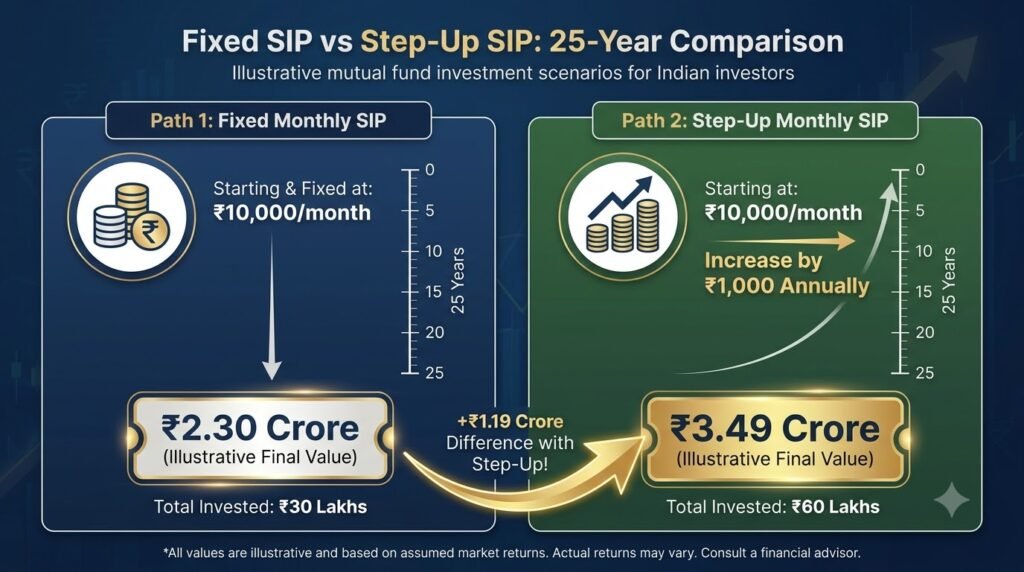
A recent WhiteOak Capital illustration reported by Moneycontrol compared two investors over 25 years.
Investor A: Fixed SIP
Starts with:
₹10,000 per month
And keeps investing ₹10,000 every month for 25 years.
Total contribution:
₹30 lakh
Illustrated final corpus:
approximately ₹2.30 crore
Investor B: Step-Up SIP
Starts with:
₹10,000 per month
But increases the monthly SIP by:
₹1,000 every year
By year 25, the monthly SIP reaches ₹34,000.
Total contribution:
approximately ₹66 lakh
Illustrated final corpus:
approximately ₹3.49 crore
Difference
₹3.49 crore − ₹2.30 crore ≈ ₹1.18 crore
| Strategy | Total Contribution | Illustrated Corpus |
| Fixed ₹10,000 SIP | ₹30 lakh | ₹2.30 crore |
| ₹1,000 Annual Step-Up | ₹66 lakh | ₹3.49 crore |
| Difference | ₹36 lakh extra invested | ~₹1.18 crore extra corpus |
Important: These figures are an illustration based on a particular historical/return analysis. Mutual-fund returns are market-linked and are not guaranteed.
SEBI provides an SIP calculator specifically as a financial-planning tool, while its investor education resources emphasise understanding mutual funds and associated risks before investing.
Where Did the Extra ₹1.18 Crore Come From?
This is the most interesting part.
The Step-Up investor contributed approximately:
₹36 lakh more
But the illustrated final corpus was approximately:
₹1.18 crore higher.
Why?
Because the additional contributions also got time to participate in investment growth.
The cited analysis estimated that roughly ₹82.48 lakh of the additional final wealth represented investment gains beyond the additional contributions themselves.
This is where people sometimes misunderstand compounding.
Compounding doesn’t mean money magically multiplies.
It means investment gains can themselves remain invested and potentially generate future gains.
And when you keep adding more capital, there is more money available to participate in that process.
The Difference Looks Small Initially
One reason people underestimate Step-Up SIPs is that the effect is not dramatic in year one or year two.
In the same 25-year illustration, the difference between the fixed and Step-Up strategies was approximately:
| Time | Additional Illustrated Corpus |
| 5 years | ₹1.25 lakh |
| 10 years | ₹7.38 lakh |
| 15 years | ₹22.59 lakh |
| 20 years | ₹53.47 lakh |
| 25 years | ₹1.18 crore |
This teaches an important investing lesson:
Long-term wealth often looks boring in the beginning.
Aap pehle 5 saal numbers dekhkar bol sakte hain:
“Bas itna hi difference?”
But give the process another 10–20 years and the numbers can look very different.

Why Can Step-Up SIP Be So Powerful?
1. Your Investment Can Grow With Your Salary
Suppose your salary increases by 8% every year.
But your SIP stays fixed forever.
Over time, investing ₹10,000 may become much easier for you—but your savings rate may actually fall relative to your income.
A Step-Up SIP helps redirect part of your salary growth toward future goals.
2. It Reduces Pressure Today
Suppose your goal requires investing ₹25,000 per month.
But today you can comfortably invest only ₹10,000.
Trying to invest ₹25,000 immediately may hurt your cash flow.
Instead, you can start with an affordable amount and progressively increase it.
This doesn’t guarantee that you’ll reach the goal—the required return, time and contribution still matter—but it can make the plan easier to follow.
3. It Can Help Fight Lifestyle Inflation
Salary increase hoti hai toh naturally lifestyle bhi improve hota hai.
Nothing is wrong with enjoying your money.
The problem starts when:
Income ↑ 10%
but
Expenses ↑ 10%
and
Investments ↑ 0%.
A simple rule can help:
Whenever income rises, send part of the increment toward investing before upgrading lifestyle.
4. You Don’t Need Higher Returns to Increase the Target Corpus
Investors often assume:
“I need a fund giving 15–18% returns.”
But higher expected returns generally come with higher uncertainty and risk.
Another way to target a larger corpus is simply to invest more over time.
This is a much more controllable variable.
Fixed SIP vs Step-Up SIP
| Feature | Fixed SIP | Step-Up SIP |
| Monthly amount | Remains same | Increases periodically |
| Easy to budget | Very easy | Requires annual adjustment |
| Suitable for rising income | Good | Potentially better aligned |
| Contribution growth | None | Yes |
| Long-term corpus potential | Lower, all else equal | Higher because more money is invested |
| Best for | Stable cash flow | Growing income |
Neither is automatically “better”.
The better strategy is the one you can sustain without compromising essential financial needs.
₹1,000 Step-Up or 10% Step-Up?
There are two common approaches.
Option 1: Fixed Amount Step-Up
Example:
₹10,000 → ₹11,000 → ₹12,000 → ₹13,000
This is easy to understand.
Best for:
Beginners who want predictable increments.
Option 2: Percentage Step-Up
Suppose you increase the SIP by 10% annually.
₹10,000 becomes:
Year 2: ₹11,000
Year 3: ₹12,100
Year 4: ₹13,310
Year 5: ₹14,641
Percentage increases compound too, so the required monthly contribution can become much larger later.
Best for:
Someone whose income is also expected to grow over time.
How Much Should You Increase Your SIP?
There is no universal answer.
Instead of randomly choosing ₹1,000 or 10%, use this framework:
Step 1: Check your annual income increase
Suppose salary goes from ₹8 lakh to ₹8.8 lakh.
Increase = ₹80,000 per year.
Step 2: Decide how much of the raise goes toward goals
For example:
50% toward better lifestyle/current expenses.
50% toward savings and investments.
Step 3: Check your financial priorities
Before increasing equity mutual-fund investments, make sure you have considered:
- Emergency fund
- Health insurance
- Appropriate life insurance where needed
- Expensive debt
- Near-term financial goals
Investment growth should not come at the cost of financial stability.
Who Should Consider a Step-Up SIP?
A Step-Up strategy can make sense for:
Young Professionals
Someone early in their career may expect income to increase over time.
Starting small and increasing investments gradually may be more realistic.
Salaried Employees
Annual increments provide a natural reminder:
Salary revision month = SIP review month.
Long-Term Investors
Step-Up SIPs are particularly relevant for long goals such as:
- Retirement
- Children’s higher education
- Financial independence
- Long-term wealth creation
Investors Whose Existing SIP Hasn’t Changed for Years
If you started ₹5,000 per month seven years ago and still invest exactly ₹5,000 despite substantial income growth, it may be worth reviewing your contribution.
When Should You NOT Increase Your SIP?
Don’t increase your SIP simply because an article told you to.
Pause the increase if:
Your Emergency Fund Is Insufficient
Investment money should not replace emergency liquidity.
You Have High-Interest Debt
A credit-card balance charging very high interest deserves serious attention before aggressively increasing investments.
Your Income Is Unstable
Freelancers, entrepreneurs and commission-based workers may need more flexible contributions.
You Need the Money Soon
Equity-oriented mutual funds can fluctuate significantly.
Money required in the near term should generally not be exposed to unnecessary equity-market volatility.
You Are Already Overinvesting at the Cost of Life
Investing should support your life.
Your life should not exist only to maximise a spreadsheet.
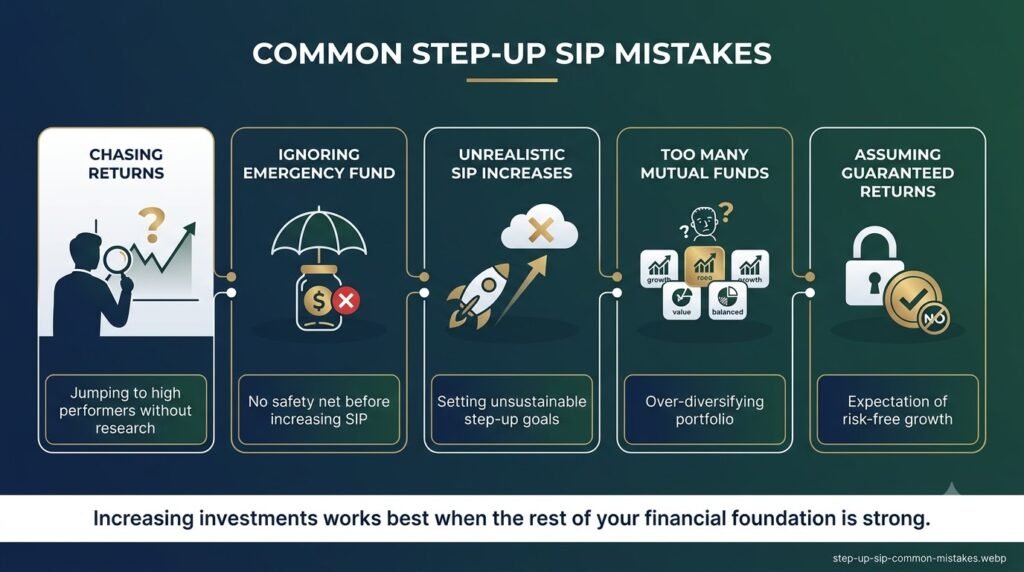
Common Step-Up SIP Mistakes
Mistake 1: Assuming 12%, 14% or Any Return Is Guaranteed
Online calculators require a return assumption.
An assumption is not a promise.
Actual mutual-fund returns fluctuate.
Mistake 2: Increasing SIP Without Increasing Emergency Savings
A bigger portfolio looks nice.
But an emergency may force you to sell investments at the wrong time if you have no cash buffer.
Mistake 3: Chasing the Best-Performing Fund Every Year
Step-Up does not mean:
“Add a new fund every year.”
Increasing your contribution and increasing the number of schemes are completely different things.
Mistake 4: Choosing an Unrealistic Step-Up Rate
A 20% annual increase sounds fantastic on a calculator.
But can your future budget support it?
The best plan is not the most aggressive one.
It is the one you can actually continue.
Mistake 5: Forgetting the Goal
Don’t increase a SIP just because “more is better.”
Connect investments to goals.
Example:
Retirement target: ₹5 crore
Time: 25 years
Existing corpus: ₹10 lakh
Current SIP: ₹20,000
Required Step-Up: Calculate based on reasonable scenarios.
Now the Step-Up has a purpose.
A Simple Step-Up SIP Action Plan
Suppose you currently invest ₹5,000/month.
Instead of asking:
“Which fund can make me rich?”
Ask:
“Can I increase this by ₹500 or ₹1,000 after every annual increment?”
Your plan might look like:
| Year | Monthly Investment |
| 2026 | ₹5,000 |
| 2027 | ₹6,000 |
| 2028 | ₹7,000 |
| 2029 | ₹8,000 |
| 2030 | ₹9,000 |
| 2031 | ₹10,000 |
Simple.
No market prediction required.
No daily portfolio checking required.
Just discipline.
Advantages of Step-Up SIP
- Investments can rise with income.
- Helps increase long-term contributions.
- Encourages disciplined investing.
- Can counter lifestyle inflation.
- May reduce the need to start with an uncomfortable SIP.
- Useful for large long-term goals.
- Easy to understand and automate where the facility is available.
Disadvantages of Step-Up SIP
- Future income growth is uncertain.
- Larger future SIPs may pressure cash flow.
- Market returns remain uncertain.
- A Step-Up cannot compensate for unsuitable asset allocation.
- An overly aggressive increase may later need to be reduced.
- More investment does not automatically mean lower risk.
FAQs
1. What is a Step-Up SIP?
A Step-Up SIP is a SIP in which your investment amount increases periodically, usually annually.
2. Is Step-Up SIP better than a normal SIP?
A Step-Up SIP can create a larger corpus because you invest more money over time. However, it is suitable only if your cash flow supports the increasing contributions.
3. Can I increase my SIP by ₹1,000 every year?
Yes, subject to the processes and facilities offered by your mutual-fund platform or AMC. You may also modify or create SIP instructions manually.
4. What happens if I increase a ₹10,000 SIP by ₹1,000 yearly?
Your SIP becomes ₹11,000 in year two, ₹12,000 in year three and continues rising by ₹1,000 each year.
5. Can ₹1,000 extra really create ₹1 crore?
Not by itself. In the cited 25-year illustration, adding ₹1,000 to the monthly SIP amount every year led to approximately ₹1.18 crore more final corpus than keeping a ₹10,000 monthly SIP fixed. The investor also contributed ₹36 lakh more over the period.
6. Does Step-Up SIP guarantee higher returns?
No. It increases the amount invested. Investment returns themselves remain market-linked and uncertain.
7. Should I use ₹1,000 or 10% Step-Up?
A fixed ₹1,000 increase is predictable, while a percentage Step-Up scales faster. Choose based on income growth and affordability.
8. Is Step-Up SIP good for retirement?
It can be useful for retirement planning because retirement is generally a long-term goal and investors may be able to increase contributions as earnings rise.
9. Should beginners use Step-Up SIP?
Beginners can use it after understanding their goals, risk tolerance, emergency-fund needs and investment product.
10. What if I cannot afford the Step-Up next year?
Review the SIP instead of hurting your cash flow. Financial plans should adapt to real life.
Conclusion
Building wealth doesn’t always require discovering an extraordinary investment.
Sometimes it requires doing an ordinary thing slightly better every year.
Start with an amount you can afford.
Stay disciplined.
Increase it as your financial capacity grows.
Aaj ₹1,000 ka increase chhota lag sakta hai. Lekin long term mein repeatedly invested money ko time milta hai grow karne ka.
The goal isn’t to chase a ₹1.18 crore headline.
The goal is to build a system where your investments grow along with your career and income.
That system can remain useful whether markets are exciting, boring or temporarily falling.
Risk Disclosure
Mutual-fund investments are subject to market risks. Returns used in examples and calculators are illustrative and should not be interpreted as guaranteed future returns. Read scheme-related documents carefully, review the applicable Riskometer, and consider your goals, time horizon and risk capacity before investing. SEBI provides investor-education material covering mutual funds and the Riskometer for investors.
Also, Read:- Should You Increase SIP During Market Correction? ₹5,000 Example Explained
How to Choose a Mutual Fund in 2026: Beginner Checklist
SIF vs Mutual Fund vs PMS: Which Investment Option Is Better for You in 2026?