
Introduction
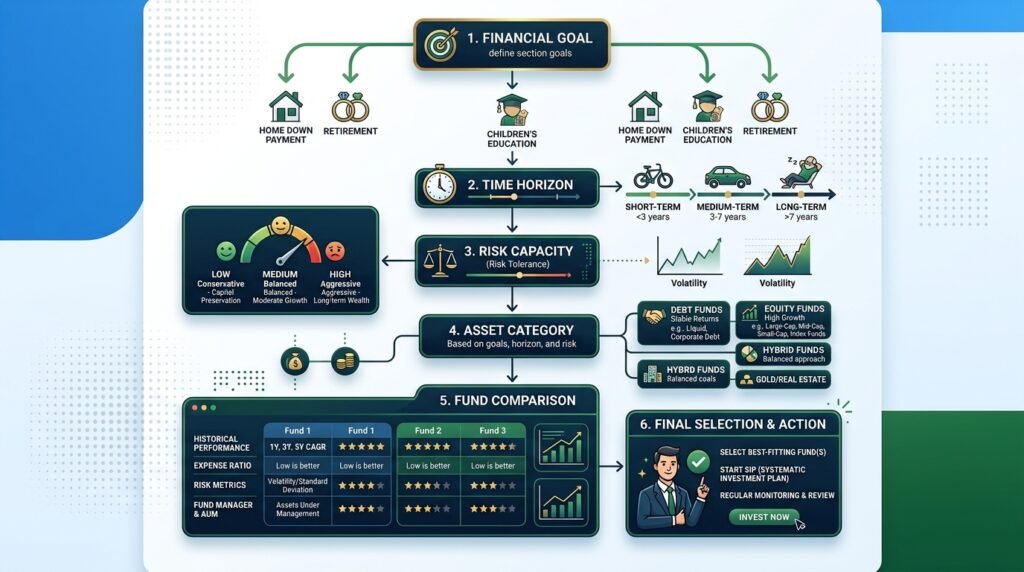
Choosing a mutual fund looks easy until you open an investment app.
Suddenly, you see hundreds of schemes with labels such as large-cap, flexi-cap, mid-cap, value, focused, balanced advantage, dynamic bond and multi-asset.
Almost every fund shows an attractive return somewhere.
This creates the most common beginner question:
“Which mutual fund should I choose?”
The better question is:
“Which mutual fund is suitable for my goal, time horizon and risk capacity?”
A fund that is suitable for a 25-year-old investing for retirement may be completely unsuitable for someone who needs the money after two years.
India’s mutual fund industry had approximately ₹82.22 lakh crore in assets under management at the end of June 2026. Monthly SIP contributions reached about ₹31,781 crore, showing how strongly Indian households are adopting systematic investing.
However, growing popularity does not mean every mutual fund is appropriate for every investor.
This guide will help you choose a mutual fund using a practical 10-step checklist—without depending on tips, star ratings or last year’s top performers.
Important: This article is for financial education. It is not personalised investment advice. Mutual fund investments are subject to market risks. Read the scheme documents carefully before investing.
Table of Contents
- Define your financial goal
- Decide your investment horizon
- Understand your risk capacity
- Choose the correct mutual fund category
- Compare performance with the right benchmark
- Study rolling returns and consistency
- Check downside risk
- Compare expense ratio, exit load and plan type
- Examine the portfolio and fund manager
- Create a final selection checklist
- Common mutual fund selection mistakes
- Beginner case study
- Frequently asked questions
Step 1: Define Your Financial Goal
Do not start by searching for the “best mutual fund.”
Start by identifying the purpose of your investment.
A financial goal gives direction to your mutual fund selection.
Your goals may include:
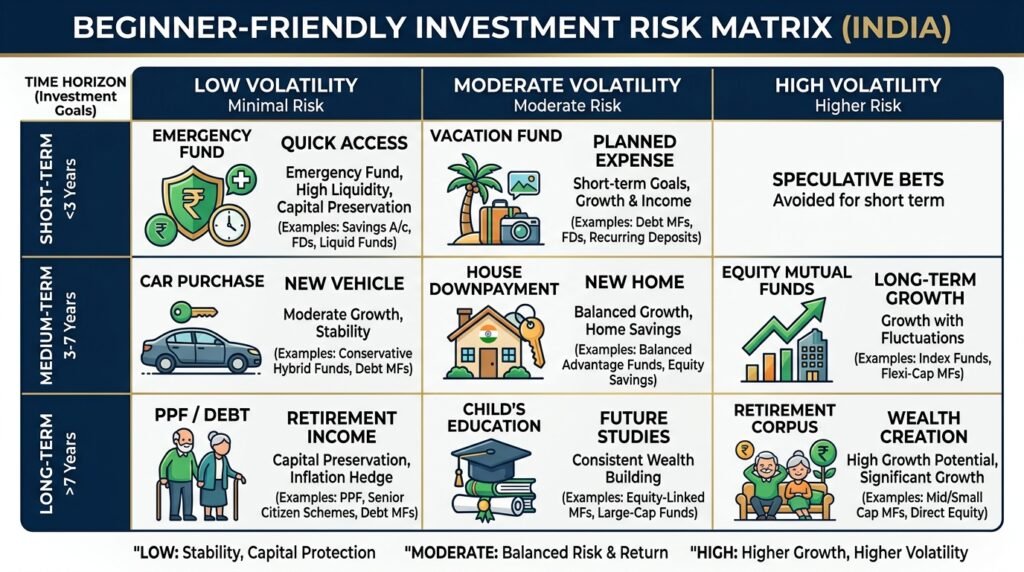
| Financial goal | Approximate time available | Main priority |
|---|---|---|
| Emergency fund | Immediate | Safety and liquidity |
| Buying a car | 2–4 years | Capital protection |
| House down payment | 4–7 years | Balanced growth and stability |
| Child’s higher education | 10–15 years | Long-term growth |
| Retirement | 20–30 years | Wealth creation |
| Annual vacation | 1–2 years | Liquidity and low volatility |
Why the goal matters
Suppose you are investing for retirement after 25 years.
Short-term market volatility may be uncomfortable, but you have enough time to recover from temporary market falls.
Now suppose you need the money for college fees after 18 months.
A sharp equity-market correction at the wrong time could seriously affect your plan.
The same mutual fund cannot be ideal for both goals.
Beginner action step
Write your goal in one sentence:
“I want to accumulate ₹20 lakh for my child’s education in 12 years.”
A specific goal is more useful than saying:
“I want good returns.”
Step 2: Decide Your Investment Horizon
Your investment horizon is the amount of time before you expect to use the money.
It is one of the most important factors in mutual fund selection.
A simple beginner framework is:
| Investment horizon | Categories generally worth studying |
| Less than 1 year | Overnight or liquid funds, depending on suitability |
| 1–3 years | Selected short-duration debt-oriented options |
| 3–5 years | Conservative or carefully selected hybrid strategies |
| 5–7 years | Hybrid or diversified equity, depending on risk capacity |
| More than 7 years | Diversified equity funds may be considered |
This is not a guaranteed formula.
Even a seven-year equity investment can produce disappointing results if the investment begins or ends during an unusual market cycle.
The key lesson is simple:
The shorter your time horizon, the less risk you can usually afford to take.
Hindi example
Man lijiye aapko do saal baad house down payment ke liye ₹5 lakh chahiye.
Agar aap poora paisa small-cap fund mein invest kar dete hain, market correction ke time corpus ₹5 lakh se girkar ₹3.75 lakh bhi ho sakta hai.
Goal fixed hai, lekin market return fixed nahi hai.
Isliye short-term goals ke liye return se pehle capital safety ko importance deni chahiye.
Step 3: Understand Your Risk Capacity
Risk tolerance and risk capacity are not the same.
Risk tolerance
Risk tolerance means how emotionally comfortable you are with market fluctuations.
You may say:
“I am comfortable taking high risk.”
But this statement is not enough.
Risk capacity
Risk capacity means how much financial loss or volatility your situation can actually absorb.
Your risk capacity depends on:
- Income stability
- Emergency savings
- Existing debt
- Number of dependants
- Insurance coverage
- Investment horizon
- Size and importance of the financial goal
- Whether you may need the money unexpectedly
Example
Rahul and Aman are both 30 years old.
Rahul has:
- A stable job
- Six months of emergency savings
- No high-interest debt
- Health and term insurance
- A 20-year investment horizon
Aman has:
- Irregular freelance income
- Credit-card debt
- No emergency fund
- Dependant parents
- A possible need for money within three years
Even if both are emotionally comfortable with risk, Rahul has a higher financial capacity to tolerate market volatility.
Use the Riskometer
Mutual fund schemes display a Riskometer to communicate the scheme’s risk level. Scheme documents may classify risk from low to very high, and investors should compare the scheme Riskometer with their own ability to bear losses.
Do not treat the Riskometer as a guarantee.
It is a starting point, not a complete suitability test.
Step 4: Choose the Correct Mutual Fund Category
Selecting the correct category is more important than selecting the top-performing fund inside the wrong category.
Major mutual fund categories
1. Equity mutual funds
Equity funds invest primarily in shares of companies.
They may offer long-term growth but can experience sharp short-term falls.
Common equity categories include:
- Large-cap funds
- Mid-cap funds
- Small-cap funds
- Large and mid-cap funds
- Flexi-cap funds
- Multi-cap funds
- Focused funds
- Value or contra funds
- Sectoral and thematic funds
- Index funds
2. Debt mutual funds
Debt funds invest in instruments such as government securities, treasury bills, corporate bonds and money-market securities.
Debt funds may carry:
- Interest-rate risk
- Credit risk
- Liquidity risk
- Reinvestment risk
“Debt” does not automatically mean “risk-free.”
3. Hybrid mutual funds
Hybrid funds combine equity and debt.
Examples include:
- Conservative hybrid funds
- Aggressive hybrid funds
- Balanced advantage funds
- Multi-asset allocation funds
- Arbitrage funds
- Equity savings funds
4. Passive funds
Index funds and exchange-traded funds attempt to track an underlying index.
Their performance depends on:
- The chosen index
- Expense ratio
- Tracking error
- Tracking difference
- Liquidity, especially for ETFs
Beginner guideline
A first-time investor usually does not need five specialised schemes.
A simple, diversified fund suited to the investor’s goal may be more useful than a complicated portfolio containing sector funds, thematic funds and several overlapping schemes.
Step 5: Compare the Fund With the Correct Benchmark
A fund’s return means little without context.
Suppose a fund generated 12% annually.
Is that good?
The answer depends on:
- What its benchmark delivered
- What similar funds delivered
- How much risk the fund took
- Whether the performance was consistent
- Whether the return came from one exceptional year
A large-cap fund should generally be compared with its relevant large-cap benchmark—not with a small-cap index, fixed deposit or gold price.
Use the Total Return Index
Where available, compare performance with a Total Return Index, commonly called TRI.
A price index measures price movement.
A Total Return Index also considers dividends generated by index constituents.
Scheme documents commonly specify an appropriate TRI benchmark for performance comparison.
Questions to ask
- Has the fund beaten its benchmark over meaningful periods?
- Did it outperform after accounting for expenses?
- Did it outperform only during one market phase?
- Did it underperform badly during corrections?
- Is the benchmark appropriate for the fund’s actual portfolio?
Do not reject a fund merely because it underperformed for one year.
Similarly, do not select it merely because it topped the chart for one year.
Step 6: Study Rolling Returns, Not Only Point-to-Point Returns
Most investment platforms display trailing returns:
- One-year return
- Three-year return
- Five-year return
These are point-to-point returns.
They measure performance between one specific starting date and one specific ending date.
That can be misleading.
What are rolling returns?
Rolling returns measure performance across many overlapping periods.
For example, three-year rolling returns may calculate the return for:
- January 2020 to January 2023
- February 2020 to February 2023
- March 2020 to March 2023
- And so on
This gives a broader view of consistency.
Why rolling returns are useful
They help you study:
- How often a fund beat its benchmark
- How often it beat its category average
- Its best and worst return periods
- Whether performance depends heavily on the investment start date
- Whether the fund remained consistent across market cycles
Beginner example
Fund A produced a five-year return of 16%.
Fund B produced a five-year return of 14%.
At first glance, Fund A looks better.
But suppose Fund A’s rolling returns were extremely unstable, while Fund B delivered more consistent outcomes across most periods.
A long-term investor may prefer consistency over occasional spectacular performance.

Step 7: Check Downside Risk
Most beginners ask:
“How much return did the fund generate?”
Experienced investors also ask:
“How badly did it fall?”
A fund can generate high returns by taking high risk.
Therefore, return should always be examined with risk.
Useful downside measures
Maximum drawdown
Maximum drawdown shows the largest fall from a previous peak to a later bottom.
For example, if the NAV falls from ₹100 to ₹70, the drawdown is 30%.
Downside capture
Downside capture examines how a fund behaved when its benchmark declined.
A lower downside capture can indicate better protection during falling markets, although the measure must be interpreted carefully.
Standard deviation
Standard deviation indicates how widely returns fluctuate around their average.
A higher figure generally means greater volatility.
Sharpe ratio
The Sharpe ratio examines return relative to overall volatility.
It should be compared only between similar funds and over similar periods.
Sortino ratio
The Sortino ratio focuses more specifically on harmful downside volatility.
Simple comparison
| Measure | Fund A | Fund B |
| Five-year annualised return | 15.2% | 14.3% |
| Maximum drawdown | -38% | -27% |
| Standard deviation | Higher | Lower |
| Downside protection | Weaker | Better |
Fund A generated the higher return.
But Fund B may be easier to hold during a market crash.
The best fund on paper is useless if its volatility causes you to panic and exit at the bottom.
Step 8: Check Expense Ratio, Exit Load and Plan Type
Costs reduce the return that remains for the investor.
Expense ratio
The expense ratio represents recurring operating expenses charged to the scheme.
It is adjusted in the NAV rather than collected from you as a separate annual bill.
A small difference can compound into a large amount over time.
Illustration
Suppose you invest ₹5,000 every month for 20 years.
At an assumed annual return of 12%, the corpus would be approximately ₹49.96 lakh.
At an assumed annual return of 10.5%, the corpus would be approximately ₹40.88 lakh.
The difference is about ₹9.08 lakh.
This illustration does not mean every expense difference will reduce returns by exactly 1.5 percentage points. Actual returns, expenses, tracking and market conditions will vary. It simply shows that seemingly small annual differences can become significant over long periods.
Direct plan vs regular plan
A regular plan is generally purchased through a distributor.
A direct plan is purchased directly with the mutual fund without routing the transaction through a distributor.
Both plans normally hold the same underlying portfolio, but their expense structures differ. Scheme documents state that expenses charged under a direct plan should not exceed corresponding expenses under the regular plan.
Which one should you choose?
A direct plan may suit investors who can independently:
- Select suitable funds
- Build asset allocation
- Review the portfolio
- Manage behaviour during market falls
- Handle taxation and rebalancing
A regular plan may involve distributor support, but investors should understand the service, incentives and ongoing cost involved.
Do not choose a direct plan merely because it is cheaper if you are likely to make costly behavioural mistakes without guidance.
Exit load
Exit load is a fee that may apply when units are redeemed before a specified period.
Check:
- Exit-load percentage
- Applicable holding period
- Whether each SIP instalment has a separate exit-load period
- Whether switches are treated as redemption
- First-in, first-out treatment
Exit-load rules vary by scheme and can change. Always read the latest Scheme Information Document.
Step 9: Examine Portfolio Quality and Fund-Manager Consistency
Do not invest only by looking at the fund name.
Study what the fund actually owns.
For equity funds, examine:
- Top 10 holdings
- Sector allocation
- Market-cap allocation
- Number of stocks
- Concentration in the largest holdings
- Cash allocation
- Portfolio turnover
- Changes in investment style
Concentration example
Fund A holds 42% of its assets in its top 10 stocks.
Fund B holds 63% in its top 10 stocks.
Fund B may be more dependent on a smaller number of companies.
That may improve returns when those companies perform well, but it can also increase downside risk.
Check for style drift
A fund may be marketed under one style but gradually start behaving differently.
For example:
- A large-cap-oriented strategy may increase mid-cap exposure
- A value fund may begin holding expensive growth stocks
- A diversified fund may become heavily concentrated in one sector
Research on Indian mutual funds has found that funds can move between investment styles over time, reinforcing the importance of checking whether the actual portfolio remains aligned with the stated strategy.
For debt funds, examine:
- Average maturity
- Modified duration
- Credit quality
- Exposure to lower-rated securities
- Concentration by issuer
- Government-security exposure
- Liquidity of underlying holdings
A debt fund displaying a slightly higher yield may be taking additional credit or duration risk.
Higher yield is not free money.
Fund-manager analysis
Check:
- How long the manager has handled the scheme
- Whether the performance record belongs to the current manager
- How other schemes managed by the same person have performed
- Whether the investment process appears repeatable
- Whether performance changed significantly after a management change
Do not assume that a famous fund manager guarantees future outperformance.
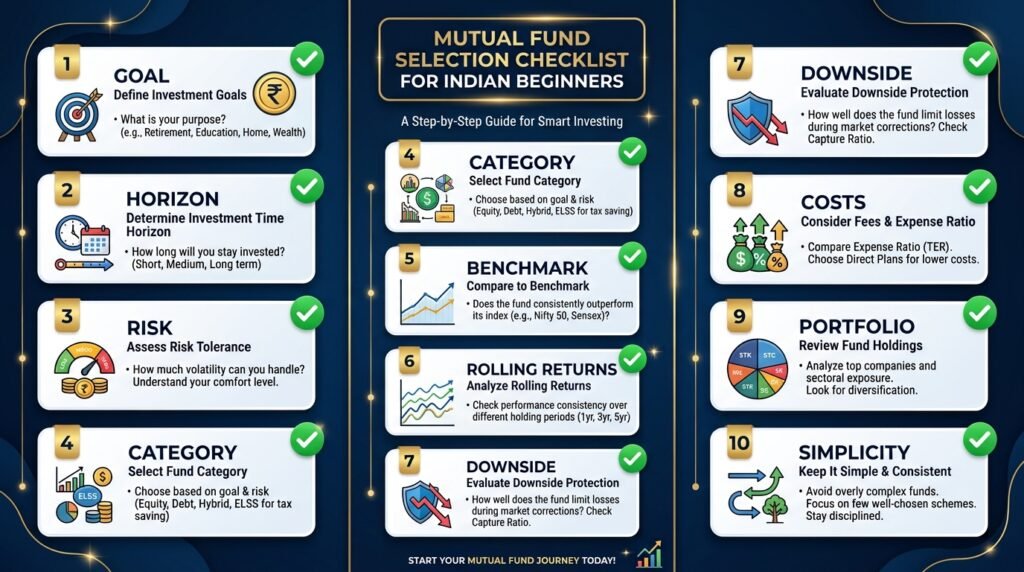
Step 10: Use a Final Mutual Fund Selection Checklist
Before investing, answer these questions.
Goal and suitability
- What is the financial goal?
- When will the money be required?
- Can the goal date be postponed?
- How much temporary loss can I tolerate?
- Is my emergency fund ready?
- Do I have adequate insurance?
- Am I carrying high-interest debt?
Fund-category check
- Does the category match my goal?
- Do I understand how the category generates returns?
- Do I understand its major risks?
- Is the scheme diversified?
- Am I adding a fund that duplicates an existing holding?
Performance check
- Is the benchmark appropriate?
- How has the fund performed across rolling periods?
- Has it performed across different market cycles?
- Did it beat the benchmark consistently?
- What was its maximum drawdown?
- Did it take excessive risk to generate returns?
Cost check
- What is the expense ratio?
- Am I selecting direct or regular?
- What is the exit load?
- Are there additional costs in the underlying structure?
- For an ETF, is trading liquidity adequate?
Portfolio check
- What are the top holdings?
- Is sector concentration excessive?
- Has the fund’s style changed?
- Is there substantial overlap with my other funds?
- Has the fund manager changed recently?
Decision check
- Can I explain in one sentence why I selected this fund?
- Would I continue investing if it underperformed for two years?
- Am I investing because of suitability or recent returns?
- Is a simpler alternative available?
- Have I read the latest scheme documents?
If you cannot explain why you own a fund, you probably need to study it further.
Beginner Case Study
Priya’s retirement SIP
Priya is 28 years old and earns ₹65,000 per month.
She wants to start a ₹7,500 monthly SIP for retirement.
Her current financial position:
- Six-month emergency fund available
- No credit-card debt
- Health insurance available
- Term insurance available
- Retirement is more than 25 years away
- Comfortable with market volatility
- No need for this money in the near term
Priya’s selection process
Step 1: Goal
Retirement wealth creation.
Step 2: Time horizon
More than 25 years.
Step 3: Risk capacity
Relatively high because the goal is distant and her basic financial protection is ready.
Step 4: Category
She studies diversified equity categories rather than sectoral or thematic funds.
Step 5: Benchmark
She compares each shortlisted scheme with its correct TRI benchmark.
Step 6: Consistency
She reviews rolling returns instead of selecting the previous year’s winner.
Step 7: Downside
She checks drawdown and performance during difficult market periods.
Step 8: Costs
She compares direct and regular plans and understands the service difference.
Step 9: Portfolio
She checks concentration, overlap and investment style.
Step 10: Simplicity
She starts with one suitable diversified fund rather than buying six funds.
Priya has not eliminated risk.
She has improved the probability that her investment matches her goal.

Common Mistakes Beginners Make
1. Selecting the previous year’s top fund
Top performers often attract investors after the strongest phase has already occurred.
Past performance does not guarantee future returns.
2. Choosing only by star rating
Ratings can be useful screening tools, but methodologies, time periods and category comparisons may differ.
A rating is not a substitute for suitability analysis.
3. Investing in too many funds
Owning 10 equity funds does not always create additional diversification.
It may create:
- Portfolio overlap
- Monitoring difficulty
- Accidental index-like exposure
- Higher behavioural confusion
4. Treating an NFO as a cheap fund
An NFO with an NAV of ₹10 is not necessarily cheaper than an existing fund with an NAV of ₹200.
NAV alone does not indicate whether a scheme is undervalued or expensive.
5. Ignoring the financial goal
A high-return fund can still be the wrong fund if it does not match the investment period.
6. Assuming debt funds cannot lose money
Debt-fund NAVs can decline due to interest-rate movements, credit events or liquidity problems.
7. Chasing sectoral themes
A theme may look attractive after strong performance, but concentrated sectors can experience long periods of underperformance.
8. Checking returns every day
Long-term investing becomes difficult when every small market movement triggers a decision.
9. Ignoring taxes and exit load
The return displayed in an app may not equal the amount you finally receive after taxes and applicable costs.
10. Changing funds too frequently
Frequent switching can result in taxes, exit loads, poor timing and unnecessary portfolio complexity.
Pros and Cons of Mutual Funds
| Advantages | Disadvantages |
| Professional portfolio management | Returns are not guaranteed |
| Diversification | Market and category risks remain |
| SIP facility | Expense ratio reduces investor returns |
| Relatively easy access | Too many choices can confuse beginners |
| Regulated structure | Performance may lag the benchmark |
| Suitable options for different goals | Wrong category selection can hurt goals |
| Transparent portfolio disclosures | Investors may chase recent returns |
Frequently Asked Questions
1. Which mutual fund is best for beginners?
There is no single best mutual fund for every beginner. The suitable category depends on the investor’s goal, time horizon, risk capacity and existing financial position.
2. How many mutual funds should a beginner invest in?
Many beginners can start with one or two suitable diversified funds. The exact number depends on the number of goals and required asset allocation. Owning many overlapping funds does not necessarily improve diversification.
3. Should beginners choose large-cap or small-cap funds?
Large-cap funds generally invest in larger companies, while small-cap funds can experience much higher volatility. A beginner should not select either category without considering the investment period and ability to tolerate losses.
4. Is SIP safer than lump-sum investing?
A SIP spreads investments across different dates and can reduce timing anxiety. It does not protect against market losses or guarantee positive returns.
5. Is a five-star mutual fund always a good investment?
No. Ratings are based on historical data and specific methodologies. They may change and do not determine whether the fund is suitable for your goal.
6. What is a good expense ratio?
A lower expense ratio is generally preferable when comparing similar strategies, but cost should not be examined in isolation. Investment process, tracking quality, risk and consistency also matter.
7. Is a direct mutual fund better than a regular mutual fund?
Direct plans generally have lower expenses because distributor-related costs are absent. Regular plans may involve distributor support. The appropriate option depends on whether the investor needs advice and what service is actually being provided.
8. What is the best date for a SIP?
There is no universally guaranteed best SIP date. Choose a date that aligns with reliable cash flow, usually soon after salary or income receipt.
9. Should I stop my SIP when the market falls?
A market fall alone is not a reason to stop a long-term SIP. Reassess the goal, emergency needs, asset allocation and fund suitability before making a decision.
10. How often should I review my mutual fund?
A detailed review once or twice a year is generally sufficient for many long-term investors unless there is a major change in the goal, fund strategy, management or personal financial situation.
11. What is portfolio overlap?
Portfolio overlap occurs when two or more funds hold many of the same securities. High overlap may create the appearance of diversification without providing meaningful additional exposure.
12. Should I invest in an NFO?
Invest only when the new scheme offers a necessary strategy that is not already available through a suitable established option. A ₹10 NFO NAV does not make the fund cheap.
13. Are index funds suitable for beginners?
A broad-market index fund may provide a transparent and relatively simple way to obtain diversified equity exposure. However, the investor must still choose the correct index and accept market risk.
14. Can debt mutual funds give negative returns?
Yes. Debt funds can produce negative short-term returns due to interest-rate changes, credit events or liquidity problems.
15. What is a mutual fund benchmark?
A benchmark is an index used to evaluate whether a scheme has delivered appropriate performance for its investment category and risk profile.
16. Should I choose dividend or growth option?
The dividend option is now commonly referred to as IDCW. Distributions are not guaranteed and can include withdrawal from distributable surplus. Growth is generally simpler for investors seeking long-term compounding, subject to individual tax and cash-flow needs.
17. What is exit load?
Exit load is a fee that may apply when you redeem mutual fund units before a specified holding period.
18. Can I lose all my money in a mutual fund?
The probability depends on the category and underlying assets. A diversified mutual fund may reduce company-specific risk, but it does not eliminate market, credit or liquidity risk.
19. Should I choose funds based on one-year returns?
No. One-year returns are heavily influenced by the recent market environment. Study longer periods, rolling returns, downside risk and investment-process consistency.
20. Do I need a financial adviser?
Professional advice may be valuable when your finances involve multiple goals, retirement planning, tax complexity, irregular income, large investment amounts or difficulty managing risk independently.
Conclusion
Choosing a mutual fund is not about finding a secret scheme that always delivers the highest return.
Such a scheme does not exist.
Good mutual fund selection means matching the investment with:
- Your goal
- Your time horizon
- Your risk capacity
- The correct asset category
- A reasonable and repeatable investment process
Man lijiye market mein 500 schemes available hain.
Aapko sabse best scheme predict nahi karni.
Aapko sirf unsuitable schemes eliminate karke ek simple, diversified aur goal-based option choose karna hai.
The objective is not to build the most exciting portfolio.
The objective is to build a portfolio that you can understand, afford and continue holding through difficult markets.
Call to Action
Before starting your next SIP, download the CompoundingLab Mutual Fund Selection Checklist and evaluate your shortlisted fund on goal suitability, risk, consistency, cost and portfolio quality.
Do not ask only:
“How much return did this fund give?”
Also ask:
“Why does this fund deserve a place in my financial plan?”
Also Read,–> Is ₹5,000 Monthly SIP Enough to Build ₹1 Crore? Realistic Calculation and Timeline