
Introduction

“Sir, main sirf ₹5,000 per month invest kar sakta hoon. Kya itne small amount se ₹1 crore ban sakta hai?”
This is one of the most common questions among beginner investors.
The simple answer is:
Yes, ₹5,000 monthly SIP se ₹1 crore ban sakta hai.
But there is one important condition.
Aapko enough time, disciplined investing, realistic return expectations and a suitable investment product chahiye.
₹5,000 aaj ek small amount lag sakta hai. Lekin jab aap same amount ko consistently 20, 25 ya 30 years tak invest karte hain, compounding ka impact kaafi powerful ho sakta hai.
The real question is not only:
Can ₹5,000 become ₹1 crore?
The better question is:
₹5,000 ko ₹1 crore banne mein kitna time lagega, aur is goal ko faster kaise achieve kiya ja sakta hai?
Let us understand the complete
in simple language.
What Is a SIP?
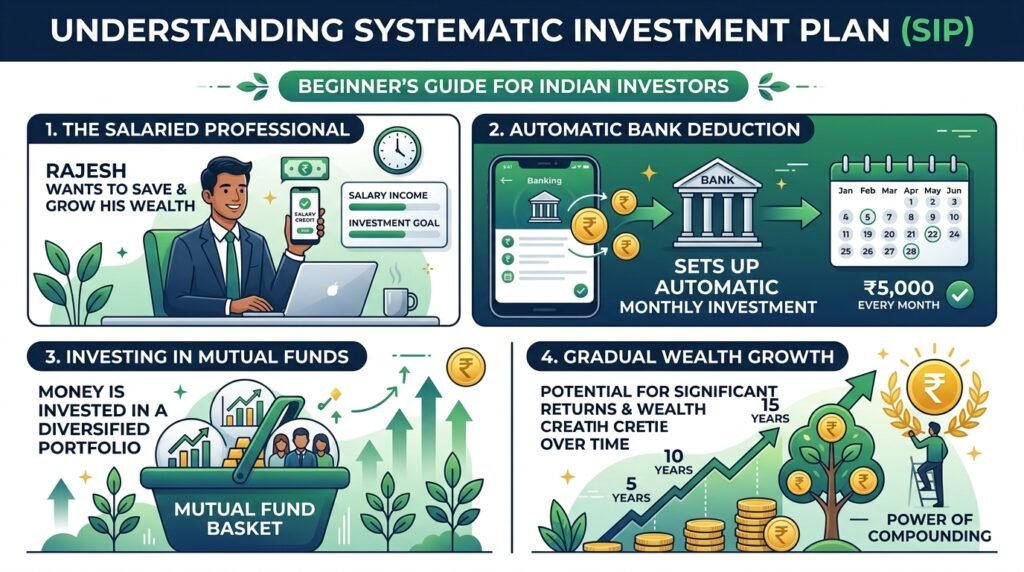
SIP stands for Systematic Investment Plan.
SIP ek method hai jiske through aap mutual fund mein fixed amount regularly invest karte hain.
Normally, most people invest monthly.
For example:
- ₹1,000 every month
- ₹3,000 every month
- ₹5,000 every month
- ₹10,000 every month
Aapke selected date par money automatically bank account se deduct hota hai aur chosen mutual fund scheme mein invest ho jata hai.
SIP ka main advantage hai discipline.
Aapko har month manually decide nahi karna padta ki market expensive hai ya cheap. Aap regularly invest karte rehte hain.
However, one thing is very important:
SIP khud koi investment product nahi hai.
SIP sirf investment karne ka method hai.
Aapka actual risk and return depend karega ki aap kis mutual fund scheme mein invest kar rahe hain.
For example, equity mutual fund SIP and debt mutual fund SIP ka risk level same nahi hota.
Can a ₹5,000 Monthly SIP Become ₹1 Crore?
Yes, mathematically it is possible.
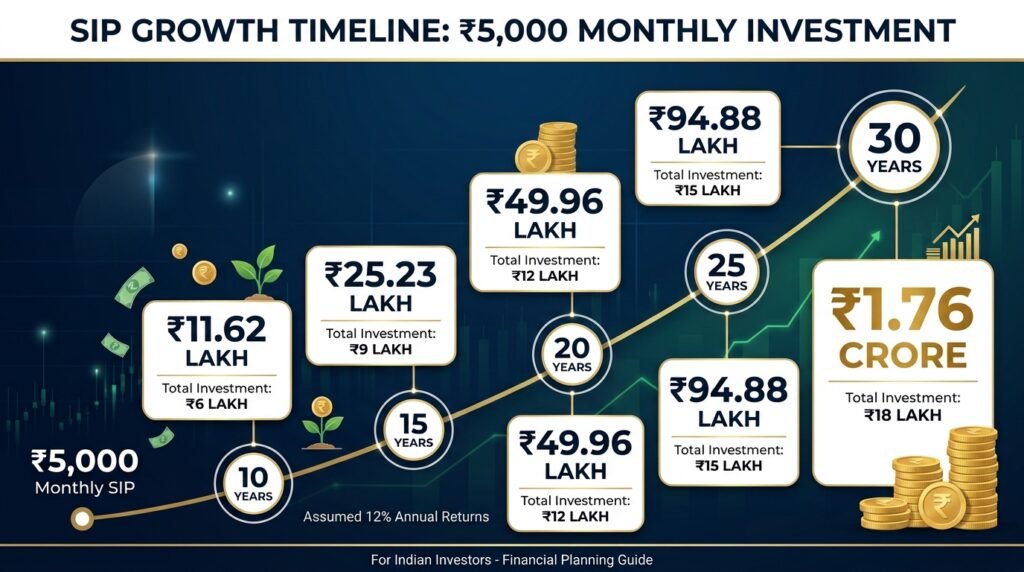
Agar hum 12% average annual return assume karein, then a ₹5,000 monthly SIP may potentially grow like this:
| Investment Period | Total Amount Invested | Estimated Corpus |
| 10 years | ₹6,00,000 | ₹11.62 lakh |
| 15 years | ₹9,00,000 | ₹25.23 lakh |
| 20 years | ₹12,00,000 | ₹49.96 lakh |
| 25 years | ₹15,00,000 | ₹94.88 lakh |
| 30 years | ₹18,00,000 | ₹1.76 crore |
At an assumed return of 12%, your investment may reach ₹1 crore in approximately 25–26 years.
Ab yahan ek interesting point notice kijiye.
In 30 years, your total personal investment is only:
₹5,000 × 12 × 30
= ₹18 lakh
But the estimated corpus is approximately ₹1.76 crore.
This means the remaining amount is mainly generated through investment growth and compounding.
Yahi long-term investing ki real power hai.
Important Note
12% return is only an assumption.
It is not guaranteed.
Mutual funds are market-linked investments. Kabhi returns high ho sakte hain, kabhi low, aur short term mein negative returns bhi possible hain.
Isliye calculation ko promise nahi, sirf illustration samajhna chahiye.
How Long Will ₹5,000 Take to Become ₹1 Crore?
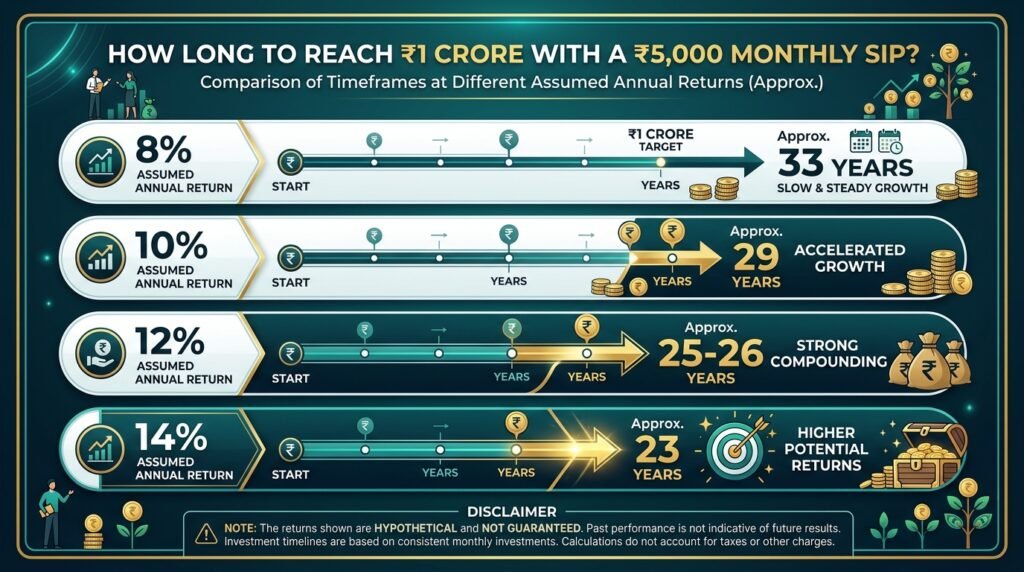
Your timeline will depend heavily on the return earned.
| Assumed Annual Return | Approximate Time to Reach ₹1 Crore |
| 8% | Around 33 years |
| 10% | Around 29 years |
| 12% | Around 25–26 years |
| 14% | Around 23 years |
Higher return se goal faster achieve ho sakta hai.
But iska matlab yeh nahi hai ki aap blindly high-risk fund choose karein only because uska recent return zyada tha.
Your investment decision should depend on:
- Your financial goal
- Investment duration
- Risk tolerance
- Income stability
- Existing savings
- Ability to handle market falls
In calculations ke liye hum assume kar rahe hain that:
- Aap every month ₹5,000 invest karte hain
- SIP stop nahi hota
- Aap beech mein money withdraw nahi karte
- Returns calculation ke liye constant maan liye gaye hain
- All gains remain invested
- Taxes and other costs separately adjust nahi kiye gaye
Real life mein returns straight line mein nahi aate.
Kisi year market 20% rise kar sakta hai.
Kisi year market 10% fall bhi kar sakta hai.
Long-term average return multiple market cycles ke baad visible hota hai.
₹5,000 SIP Returns at Different Rates
Let us compare how different return assumptions affect your corpus.
₹5,000 SIP After 10 Years
| Assumed Return | Total Investment | Estimated Corpus |
| 8% | ₹6,00,000 | ₹9.21 lakh |
| 10% | ₹6,00,000 | ₹10.33 lakh |
| 12% | ₹6,00,000 | ₹11.62 lakh |
First 10 years mein 8% and 12% returns ka difference bahut huge nahi lagta.
But compounding needs time.
Jab investment period 20, 25 ya 30 years ka hota hai, even 1%–2% return difference final corpus mein major difference create kar sakta hai.
However, higher expected return generally comes with higher risk.
Isliye sirf higher return chase karna smart strategy nahi hai.
How Is the SIP Corpus Calculated?
A future SIP value is usually estimated using this formula:
Future Value = P × [((1 + r)ⁿ − 1) ÷ r] × (1 + r)
Where:
- P = Monthly SIP amount
- r = Monthly expected return
- n = Total number of monthly investments
For example, for a ₹5,000 SIP at an assumed 12% annual return:
- Monthly SIP = ₹5,000
- Monthly expected return = 12% ÷ 12
- Investment duration = 25 years
- Total instalments = 300
The estimated corpus is approximately ₹94.88 lakh.
A few additional months of investing may take the corpus above ₹1 crore, assuming similar returns continue.
Aapko formula memorise karne ki zarurat nahi hai.
Bas yeh samajhiye ki SIP result mainly three factors se decide hota hai:
- Monthly investment amount
- Investment duration
- Investment return
In teen factors mein se investment duration and contribution amount aapke control mein hain.
Market return aapke control mein nahi hai.
Why Does the Corpus Grow Faster in Later Years?
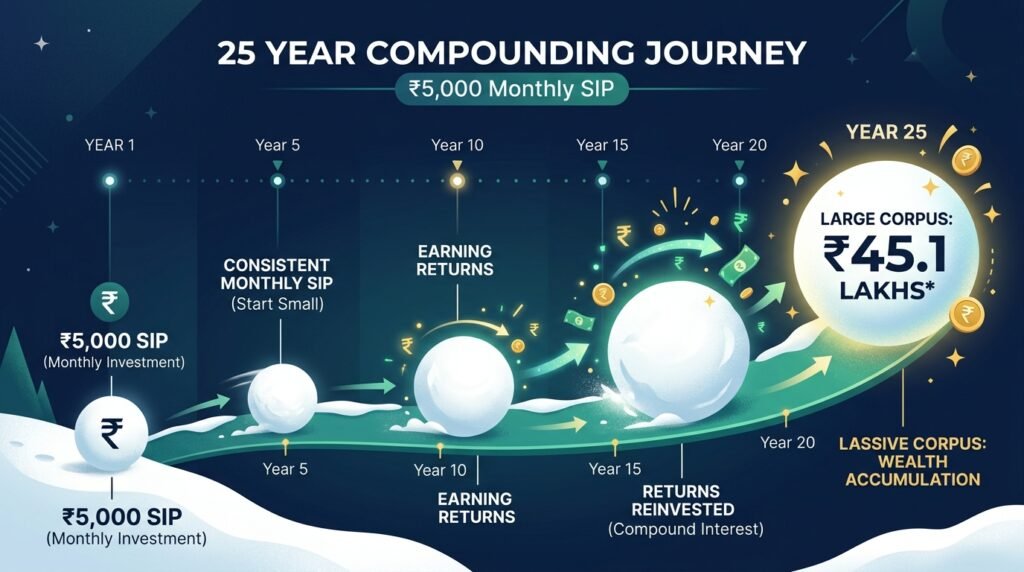
Compounding ka effect starting se same speed par visible nahi hota.
Initial years mein portfolio small hota hai.
Isliye even a good percentage return generates only a small rupee gain.
For example:
- 12% return on ₹5 lakh = ₹60,000
- 12% return on ₹50 lakh = ₹6 lakh
- 12% return on ₹1 crore = ₹12 lakh
Percentage same hai.
But rupee value completely different hai.
This is why the final years of a long-term investment journey can create much more wealth than the early years.
Simple Example
Compounding ko snowball ki tarah samajhiye.
Initially snowball small hota hai and slowly grow karta hai.
Jaise-jaise snowball bigger hota hai, har rotation mein more snow collect karta hai.
Investment bhi same way grow karta hai.
Aapke previous returns bhi future mein returns generate karte hain.
This is called returns on returns.
₹5,000 SIP for 20 Years: Is It Enough?

At an assumed return of 12%, a ₹5,000 monthly SIP may grow to approximately ₹49.96 lakh in 20 years.
Your total investment would be:
₹5,000 × 12 × 20
= ₹12 lakh
Estimated wealth gain:
₹49.96 lakh − ₹12 lakh
= ₹37.96 lakh
This is a strong result.
But ₹1 crore target ke comparison mein yeh still roughly half hai.
Therefore, if your goal period is only 20 years, then you may need to:
- Invest more than ₹5,000 per month
- Increase your SIP every year
- Add occasional lump-sum investments
- Extend the investment period
- Use a combination of these strategies
Do not try to solve the gap by assuming unrealistic returns.
Instead of expecting 18%–20% return, it is more practical to increase your monthly savings.
How Much SIP Is Required for ₹1 Crore in 20 Years?
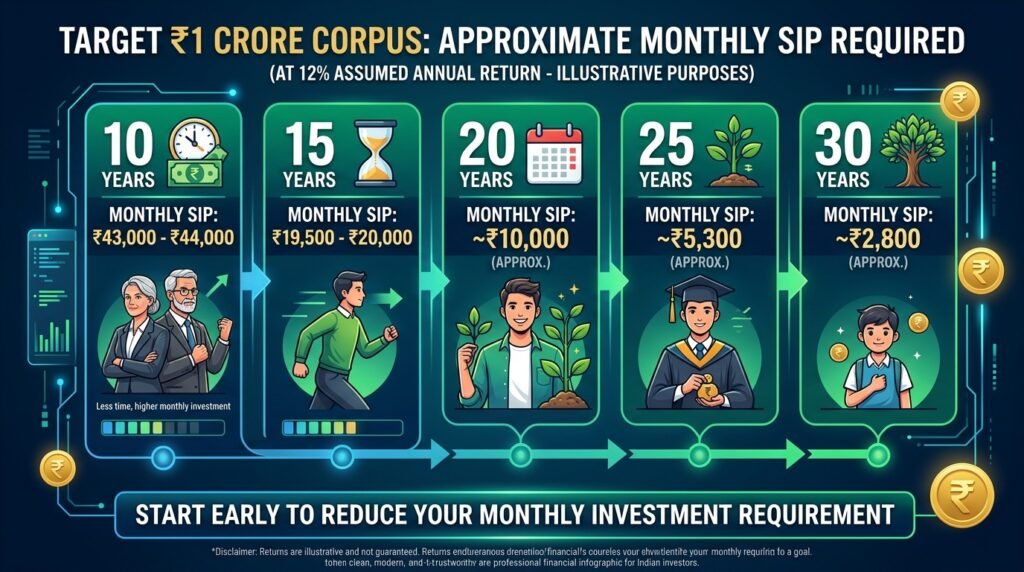
At an assumed annual return of 12%, you may need a monthly SIP of approximately ₹10,000 to target ₹1 crore in 20 years.
The exact amount may differ slightly depending on calculation method and investment timing.
| Goal Duration | Approximate Monthly SIP at 12% |
| 10 years | ₹43,000–₹44,000 |
| 15 years | ₹19,500–₹20,000 |
| 20 years | Around ₹10,000 |
| 25 years | Around ₹5,300 |
| 30 years | Around ₹2,800 |
This table clearly shows one important lesson:
Time reduces the amount you need to invest every month.
Agar aap 10 years late start karte hain, required SIP dramatically increase ho sakta hai.
Early investing gives compounding more time to work.
The Better Strategy: Start With ₹5,000 and Use a Step-Up SIP
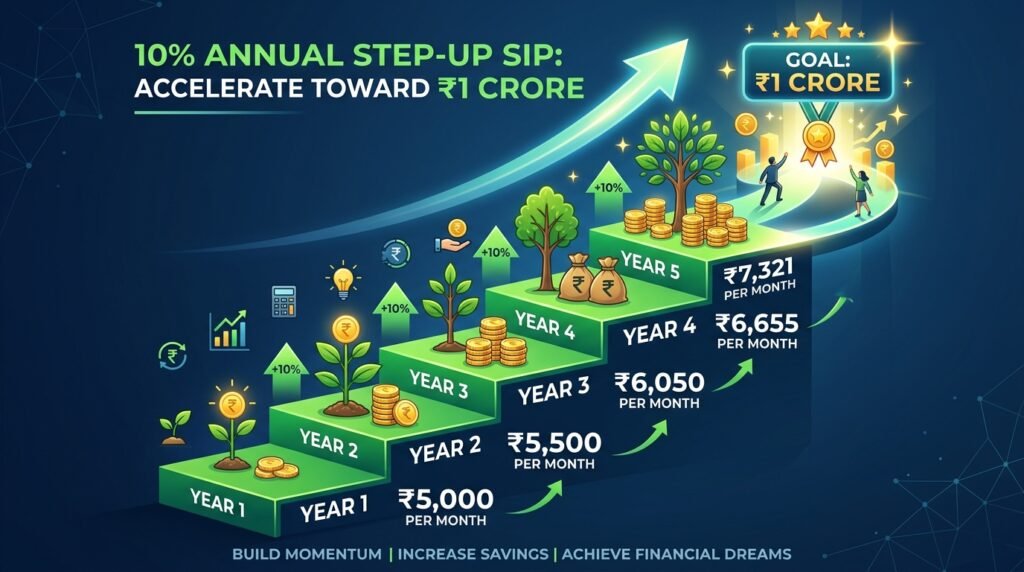
A fixed ₹5,000 SIP is a good starting point.
But ideally, your SIP should increase as your income grows.
A step-up SIP means increasing your monthly investment every year.
For example:
| Year | Monthly SIP |
| Year 1 | ₹5,000 |
| Year 2 | ₹5,500 |
| Year 3 | ₹6,050 |
| Year 4 | ₹6,655 |
| Year 5 | ₹7,321 |
This example assumes a 10% annual SIP increase.
First look mein increase small lag sakta hai.
But over 15–20 years, this strategy can make a huge difference.
Why Step-Up SIP Works
Suppose your salary increases by 8%–10% every year.
Agar aap complete salary hike lifestyle expenses mein use kar dete hain, your savings may remain unchanged.
Instead, salary hike ka ek portion SIP increase karne ke liye use kijiye.
For example:
Aaj SIP ₹5,000 hai.
Next year ₹5,500 kar dijiye.
Uske next year ₹6,050.
Har year small increase long term mein large corpus create kar sakta hai.
Simple rule: Whenever your income increases, try to increase your SIP by at least 5%–10%.
How to Reach ₹1 Crore Faster
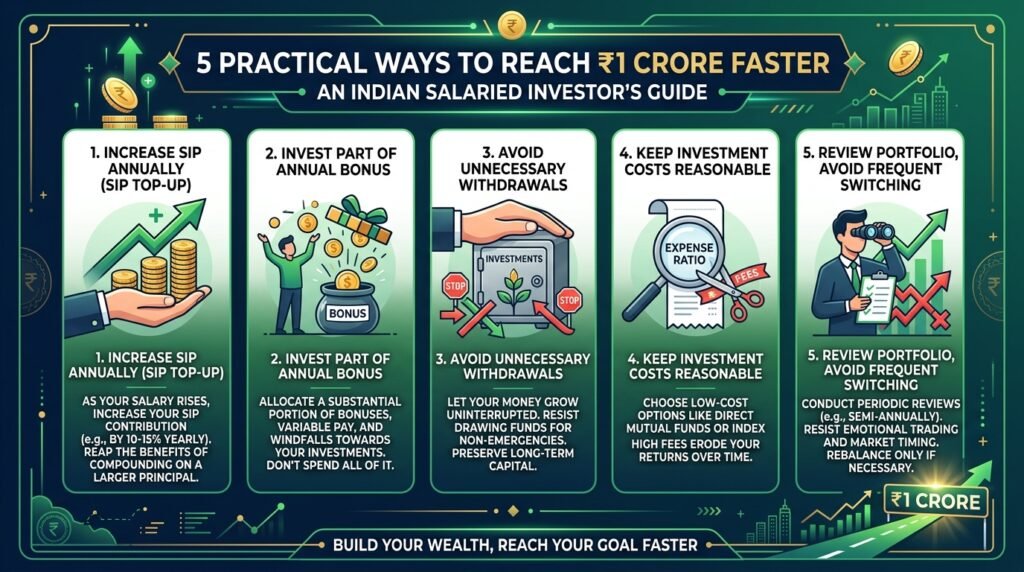
1. Increase Your SIP Every Year
This is one of the most practical methods.
A person earning ₹35,000 today may not be able to invest ₹15,000 immediately.
But they may start with ₹5,000 and gradually increase the amount with every salary hike.
Starting small is better than waiting for the perfect salary.
2. Invest Part of Your Bonus
You can invest a portion of:
- Annual bonus
- Performance incentive
- Freelance income
- Tax refund
- Festival bonus
- Side-business income
Even an additional ₹25,000 or ₹50,000 invested occasionally may shorten the journey.
3. Avoid Unnecessary Withdrawals
Compounding ko uninterrupted time chahiye.
Agar aap long-term investment ko phone, holiday, wedding expense ya car down payment ke liye repeatedly withdraw karte hain, corpus growth slow ho jayegi.
Create a separate emergency fund so that you do not need to disturb long-term investments.
4. Keep Investment Costs Reasonable
Higher costs reduce the amount that remains invested.
Before selecting a mutual fund, check:
- Expense ratio
- Exit load
- Portfolio
- Risk level
- Investment strategy
- Long-term consistency
Do not choose a scheme only because it gave the highest return last year.
5. Review, But Do Not Keep Switching
Portfolio ko once or twice a year review karna enough ho sakta hai for many long-term investors.
Har few months fund change karna usually helpful nahi hota.
Frequent switching may lead to:
- Exit load
- Taxes
- Emotional decisions
- Performance chasing
- Portfolio confusion
A fund ka six months underperform karna automatically usse bad fund nahi banata.
What Will ₹1 Crore Be Worth After 25 Years?

This is one of the most important questions.
₹1 crore after 25 years will not have the same purchasing power as ₹1 crore today.
Assume inflation is 6%.
Then ₹1 crore received after 25 years may have purchasing power similar to approximately ₹23 lakh today.
In simple words:
Jo lifestyle aaj ₹23 lakh mein possible hai, same lifestyle future mein ₹1 crore cost kar sakta hai.
This is why ₹1 crore should not be treated as a universal goal.
You need to calculate the future cost of your specific goal.
Example: Retirement Goal
Suppose your current annual household expense is ₹6 lakh.
At 6% inflation, the same lifestyle may cost approximately ₹25.8 lakh per year after 25 years.
In that situation, a ₹1 crore retirement corpus may not be enough.
The real goal should not only be:
Mujhe crorepati banna hai.
The better goal is:
Mujhe future expenses comfortably cover karne ke liye kitna corpus chahiye?
Where Should You Invest the ₹5,000 SIP?
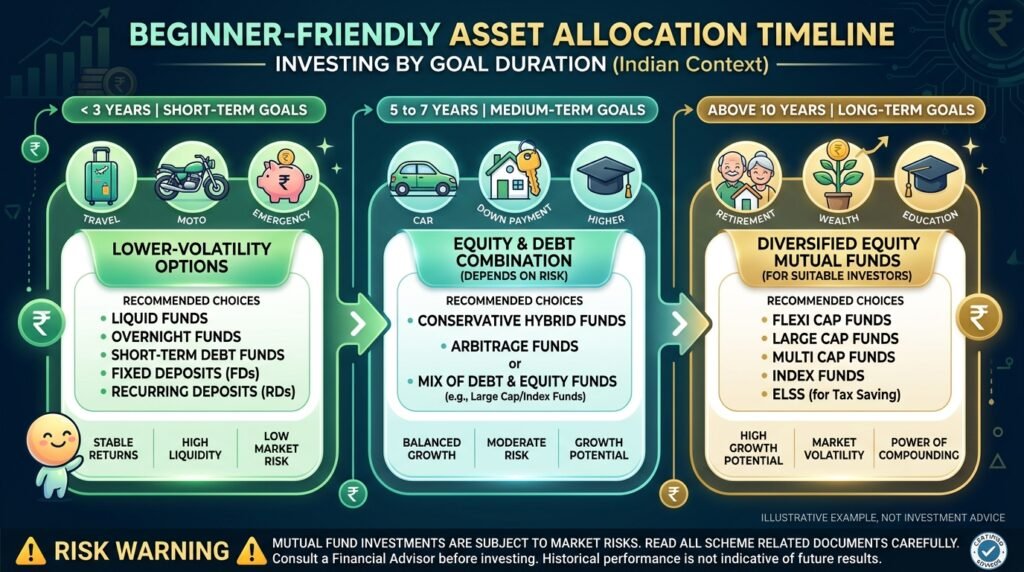
The right investment depends on your goal duration and risk profile.
For Goals Within Three Years
Short-term goals ke liye equity mutual funds risky ho sakte hain.
Market short period mein fall kar sakta hai.
For short-term goals, lower-volatility options may be considered after checking risk, liquidity and taxation.
For GoalsAround Five to Seven Years
A combination of equity and debt may be suitable for some investors.
But seven years ka period bhi guaranteed positive equity return nahi deta.
Your asset allocation should match your risk profile.
For Goals Above Ten Years
Investors with a long horizon and ability to tolerate volatility may consider diversified equity mutual funds.
Possible categories include:
- Broad-market index funds
- Flexi-cap funds
- Large-and-mid-cap funds
- Aggressive hybrid funds
This is not a recommendation for any specific fund.
Before investing, understand:
- The fund’s objective
- Riskometer
- Portfolio composition
- Expense ratio
- Exit load
- Your own risk capacity
Index Fund vs Active Fund
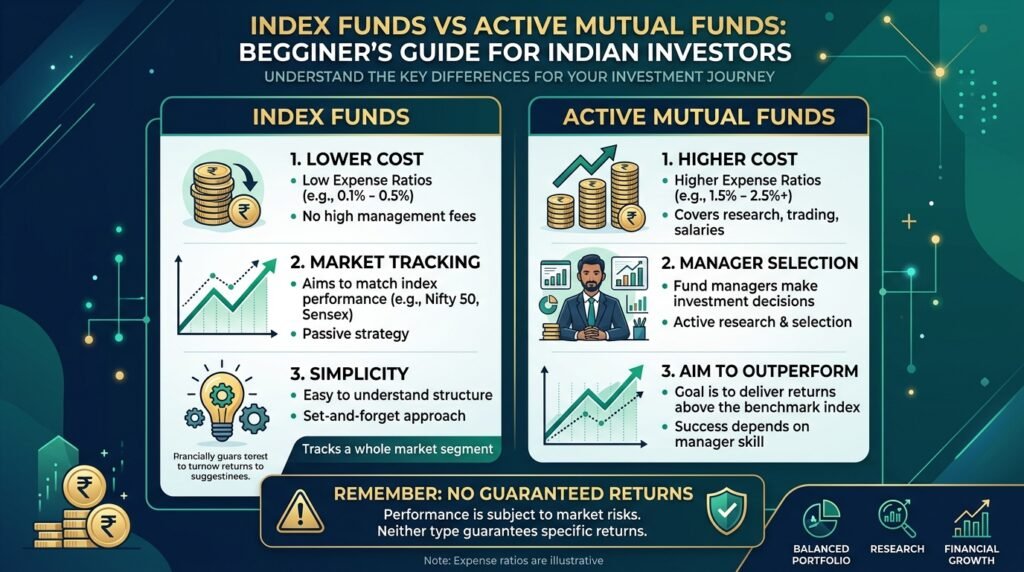
Both can be useful, but they work differently.
| Factor | Index Fund | Active Fund |
| Investment Style | Tracks a market index | Fund manager selects investments |
| Cost | Usually lower | Usually higher |
| Objective | Match index performance before costs | Try to outperform benchmark |
| Fund Manager Risk | Lower | Higher |
| Simplicity | Easier to understand | Requires more evaluation |
| Guaranteed Return | No | No |
For a beginner who wants simplicity, a broad-market index fund may be easier to understand.
Active funds may also perform well, but selecting them only on one-year performance is not a sound strategy.
Common Mistakes While Investing ₹5,000 Per Month

Mistake 1: Expecting ₹1 Crore in 10 Years
A ₹5,000 SIP is unlikely to become ₹1 crore in 10 years under realistic return assumptions.
At 12%, it may grow to around ₹11.62 lakh.
Agar koi advertisement ₹5,000 se very quickly crorepati banne ka promise kar raha hai, be careful.
Mistake 2: Assuming 12% Return Is Guaranteed
12% is only an assumption.
Mutual funds do not provide fixed or guaranteed returns.
Past performance future returns guarantee nahi karta.
Mistake 3: Stopping SIP During a Market Fall
Many beginners panic when markets fall.
They stop SIP after seeing negative returns.
But when markets fall, the same SIP amount may buy more units.
Aapko SIP tab stop karni chahiye when your financial goal, income situation or investment suitability has changed—not only because market temporarily down hai.
Mistake 4: Choosing Funds Based on Recent Returns
Last year ka top-performing fund next year top-performing rahega, this is not guaranteed.
Evaluate:
- Long-term consistency
- Risk
- Portfolio quality
- Fund strategy
- Costs
- Benchmark performance
Do not chase rankings blindly.
Mistake 5: Ignoring Emergency Fund
Do not invest all your available money in equity funds.
First build an emergency fund.
Ideally, it may cover around three to six months of essential expenses, depending on your job, income stability and family responsibilities.
Emergency fund ke bina, unexpected expense aapko long-term SIP redeem karne par force kar sakta hai.
Mistake 6: Investing Without a Clear Goal
₹1 crore is only a number.
It is not a complete financial plan.
You should know:
- Why you need the money
- When you need it
- What the future cost will be
- How much risk you can take
- How much you can invest regularly
Expert Tips for Building a ₹1 Crore Corpus
Automate the SIP
Set the SIP date close to your salary date.
Pehle invest kijiye, phir remaining amount spend kijiye.
Month-end par jo paisa bachega usse invest karenge—this approach often fails.
Increase SIP With Every Salary Hike
Even a 5% annual increase can be useful.
Do not keep your SIP fixed at ₹5,000 for 25 years if your income is increasing.
Create Separate Investments for Separate Goals
Do not use one SIP for everything.
Retirement, child education, home purchase and travel are different goals.
Each goal may require a different timeline and asset allocation.
Reduce Risk as the Goal Gets Closer
Suppose your goal is only two years away.
At that stage, keeping the entire corpus in a highly volatile asset may be risky.
As the goal approaches, gradually reducing risk may help protect the accumulated corpus.
Focus on Behaviour
The best-performing fund cannot help if you:
- Stop investing frequently
- Panic during corrections
- Chase trending sectors
- Withdraw impulsively
- Increase expenses with every salary hike
Long-term wealth creation depends heavily on behaviour.
Frequently Asked Questions
1. Can ₹5,000 SIP become ₹1 crore?
Yes. At an assumed annual return of 12%, it may take approximately 25–26 years. Actual results will depend on market performance.
2. How much can ₹5,000 SIP generate in 10 years?
At an assumed 12% return, it may grow to approximately ₹11.62 lakh.
3. How much can ₹5,000 SIP generate in 20 years?
At an assumed 12% return, the estimated corpus may be around ₹49.96 lakh.
4. How much can ₹5,000 SIP generate in 25 years?
At an assumed 12% return, it may grow to approximately ₹94.88 lakh.
5. Is 12% mutual fund return guaranteed?
No. Mutual fund returns are market-linked and are never guaranteed.
6. How can I reach ₹1 crore faster?
Increase your SIP every year, invest part of your bonuses and avoid unnecessary withdrawals.
7. Is ₹5,000 a good SIP amount for beginners?
Yes. ₹5,000 is a meaningful starting amount if it fits your budget and does not affect essential expenses or emergency savings.
8. Which mutual fund is best for a ₹5,000 SIP?
There is no single best fund for everyone. The right choice depends on your goal, time horizon and risk tolerance.
9. Can I divide ₹5,000 into multiple funds?
Yes, but too many funds can create unnecessary complexity. For a ₹5,000 SIP, you may not need four or five similar schemes.
10. Should I stop SIP during a market crash?
A market fall alone is usually not enough reason to stop. Review your goal, financial situation and fund suitability before taking action.
11. Is SIP tax-free?
No. Taxation depends on the mutual fund type, holding period and applicable tax rules at the time of redemption.
12. What happens if I miss one SIP?
Missing one SIP usually does not affect your existing investment. However, bank charges or mandate-related conditions may apply.
13. Can I increase my SIP later?
Yes. You may increase the SIP amount or create an additional SIP, depending on the platform and scheme.
14. Is step-up SIP better than fixed SIP?
A step-up SIP can help you reach your goal faster because your contribution grows over time.
15. Is ₹1 crore enough for retirement?
Not necessarily. It depends on your retirement expenses, inflation, lifestyle, retirement age and other income sources.
16. Can debt mutual funds create ₹1 crore from ₹5,000?
Potentially, but lower expected returns may require more time or a higher monthly investment.
17. Is an index fund suitable for long-term SIP?
A diversified index fund may be suitable for some investors, but it still carries market risk.
18. Which SIP date is best?
Over the long term, consistency is usually more important than choosing a perfect SIP date.
19. Can I withdraw SIP money anytime?
Many open-ended mutual funds allow redemption, but exit load, tax, lock-in or settlement rules may apply.
20. Should I borrow money to start a SIP?
Borrowing to invest increases risk and is generally not suitable for beginner investors.
Conclusion
A ₹5,000 monthly SIP can potentially build a ₹1 crore corpus.
But it is not a quick-rich scheme.
At an assumed annual return of 12%, the journey may take approximately 25–26 years.
At lower returns, it may take longer.
The good news is that your SIP does not need to remain fixed forever.
Aap ₹5,000 se start kar sakte hain.
Then every year, salary increase ke saath SIP bhi increase kar sakte hain.
You may also invest part of your annual bonus and avoid unnecessary withdrawals.
Man lijiye aap aaj ₹5,000 se start karte hain and every year SIP ko 10% increase karte hain.
Aaj ka small decision future mein aapki financial life par big impact create kar sakta hai.
The starting amount matters.
But your consistency, patience and behaviour matter even more.
Disclaimer
This article is only for financial education and should not be treated as investment, tax or legal advice.
Mutual fund investments are subject to market risks. Read all scheme-related documents carefully before investing.
Returns mentioned in this article are hypothetical illustrations and are not guaranteed.
Consider consulting a SEBI-registered investment adviser or qualified financial professional before making investment decisions.
Also Read:- What Is Compounding? A Beginner-Friendly Guide With Examples
SIF vs Mutual Fund vs PMS: Which Investment Option Is Better for You in 2026?
Article is very good for beginners