
Small Cap vs Mid Cap vs Large Cap Mutual Funds in 2026: Where Is Investor Money Going?
According to July 2026 AMFI data, small-cap mutual funds attracted approximately ₹7,767.50 crore, mid-cap funds received ₹6,192.31 crore, while large-cap funds recorded an outflow of ₹1,321.69 crore. Small-cap and mid-cap funds together accounted for more than half of equity mutual-fund inflows during July. according to AMFI’s July 2026 mutual fund data
Table of Contents
- What are Large Cap, Mid Cap and Small Cap Funds?
- Where is investor money going?
- Why are Small Cap funds attracting so much money?
- Why are Mid Cap funds popular?
- Why did Large Cap funds see outflows?
- Large vs Mid vs Small Cap comparison
- Which category is suitable for beginners?
- Example portfolio allocation
- Common mistakes
- What should existing SIP investors do?
- FAQs
- Final conclusion
What Does Large Cap, Mid Cap and Small Cap Actually Mean?
Before looking at returns or fund flows, understand one simple concept: market capitalisation.
Market capitalisation means the total market value of a listed company.
SEBI’s framework classifies companies broadly as:
| Category | Company Ranking by Market Capitalisation |
|---|---|
| Large Cap | 1st–100th |
| Mid Cap | 101st–250th |
| Small Cap | 251st onwards |
These categories follow SEBI’s mutual fund categorisation framework, which also specifies how much a large-cap, mid-cap or small-cap scheme must invest in its respective market-cap segment.
Large-cap mutual funds are required to invest at least 80% of their assets in large-cap companies. Mid-cap and small-cap funds generally need at least 65% exposure to their respective categories.
A simple Indian example
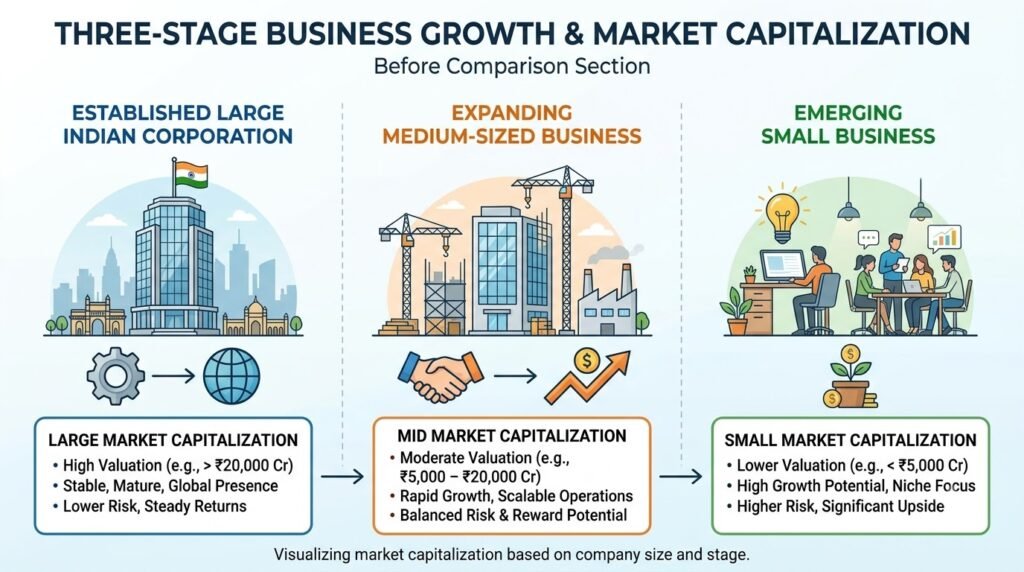
Imagine three businesses.
Large Cap: An established nationwide business with thousands of employees, strong cash flows and access to capital.
Mid Cap: A successful company expanding rapidly into new cities and product categories.
Small Cap: A much smaller listed business which may become a major company one day—but may also struggle if its growth plans fail.
Yehi basic difference mutual fund risk mein bhi dikhta hai.
The smaller the company, generally the greater the potential opportunity—but also the greater the uncertainty.
Where Is Investor Money Going Right Now?
July 2026 gives us an unusually clear picture.
| Fund Category | June 2026 Net Flow | July 2026 Net Flow | Change |
| Small Cap | ₹5,601.96 crore | ₹7,767.50 crore | +38.7% |
| Mid Cap | ₹6,090.17 crore | ₹6,192.31 crore | +1.7% |
| Large Cap | +₹2,067.48 crore | -₹1,321.69 crore | Outflow |
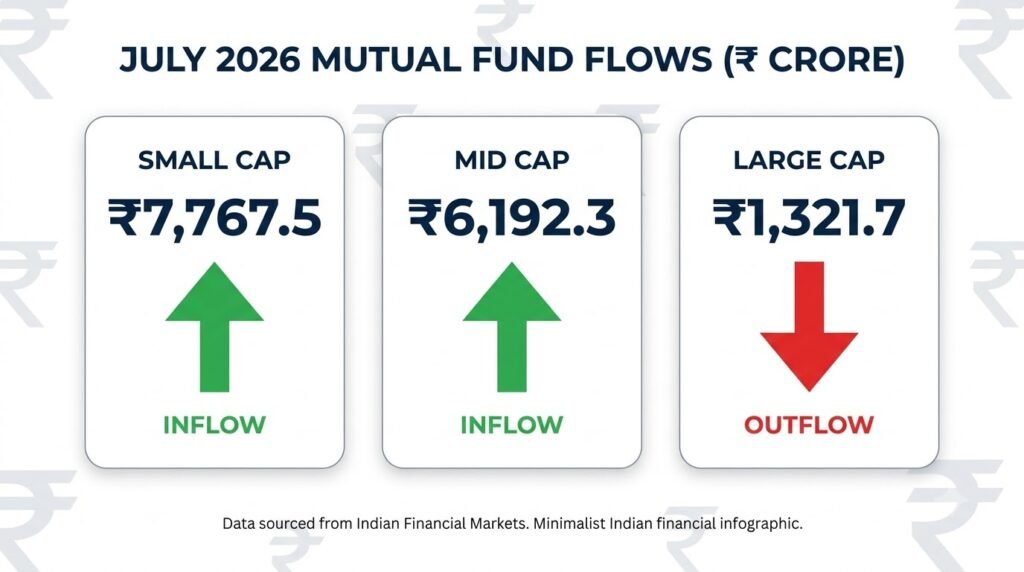
Small-cap and mid-cap funds together received almost ₹13,960 crore.
That was approximately 56.5% of the ₹24,697.39 crore flowing into actively managed equity mutual funds during July.
There is another interesting point.
Total equity inflows actually declined roughly 14.8% from June.
So investors were not simply becoming more bullish on everything.
Instead, money became increasingly concentrated toward specific higher-growth categories—especially small caps.
Why Are Investors Putting So Much Money Into Small Cap Funds?
There are several possible reasons.
1. Strong historical returns attract attention
Returns influence investor behaviour.
ICRA Analytics data reported that, as of June 30, 2026, small-cap funds had generated average category returns of approximately 17.68% CAGR over three years and 17.06% over five years.
Large-cap funds were around 10.65% over three years and 10.22% over five years in the same comparison.
Naturally, many investors look at these numbers and think:
“Large cap ne 10% diya, small cap ne 17% diya. Toh small cap better hai.”
But this reasoning has one major problem.
Past returns tell you what happened. They do not tell you what will happen next.
2. Small-cap momentum creates FOMO
The Nifty Smallcap 250 recently reached a fresh 52-week high, bringing small-cap investing back into focus.
When investors repeatedly see headlines about small-cap rallies, top-performing schemes and high historical returns, FOMO can develop.
FOMO means Fear of Missing Out.
A beginner may start thinking:
“Sab small cap mein invest kar rahe hain. Main peeche na reh jaun.”
This is precisely when discipline becomes important.
A fund category receiving ₹7,000+ crore in one month does not automatically make it suitable for your financial goal.
3. Investors believe smaller companies have higher growth potential
A ₹5 lakh crore company doubling its business is difficult.
A much smaller business doubling its revenue may be easier if it successfully enters new markets.
This growth possibility is one reason investors accept greater volatility in smaller companies.
Market experts interviewed by Moneycontrol also pointed toward stronger earnings growth in parts of the broader market as one factor supporting interest in mid- and small-cap companies.
But higher growth expectations are often accompanied by higher valuations.
And higher expectations create another risk:
If earnings disappoint, share prices can correct sharply.
Why Are Mid Cap Funds Also Attracting Investors?
Mid caps sit between the two extremes.
They usually do not have the scale and stability of large companies.
But many are more mature than smaller businesses.
That makes the category attractive to investors looking for a balance between growth potential and risk.
ICRA data showed mid-cap fund AUM rising from around ₹4.32 lakh crore in June 2025 to ₹5.06 lakh crore in June 2026.
Small-cap AUM increased from approximately ₹3.55 lakh crore to ₹4.30 lakh crore over the same period.
Investor participation has therefore been building for more than just one month
Then Why Did Large Cap Funds See Outflows?
Large-cap mutual funds went from a ₹2,067.48 crore inflow in June to a ₹1,321.69 crore outflow in July—a monthly flow swing of approximately ₹3,389 crore.
Should large-cap investors panic?
No.
A single month of fund flows does not tell us which category will produce the highest future returns.
Large-cap companies generally remain the biggest and most established businesses in the market.
Large caps can also play an important portfolio role when markets become volatile.
Think about cricket.
A team cannot contain only aggressive six-hitters.
Sometimes you need players who can protect their wicket, rotate strike and keep the innings stable.
Portfolio construction works similarly.
Small caps may provide aggression.
Mid caps may provide growth.
Large caps can provide relative stability.
A good portfolio is a team—not a competition to find one permanent winner.
Large Cap vs Mid Cap vs Small Cap Mutual Funds
| Factor | Large Cap | Mid Cap | Small Cap |
| Companies | Top 100 | 101–250 | 251 onwards |
| Relative Risk | Lower | Higher | Highest |
| Volatility | Lower | High | Very High |
| Growth Potential | Moderate | High | Potentially High |
| Liquidity | Generally highest | Good | Can be lower |
| Beginner Friendly | More suitable | Requires experience | Requires high risk tolerance |
| Practical Horizon | Long term | Longer term | Very long term |
| Portfolio Role | Core/Stability | Growth | Satellite/Aggressive growth |
“Lower risk” here does not mean no risk.
All three are equity categories.
Capital can fall significantly during market corrections.
Which One Is Best for Beginners in 2026?
This is the wrong question:
“Which category is giving the highest return?”
A much better question is:
“Which category matches my goal, time horizon and ability to handle market falls?”
Read this:- How to Choose a Mutual Fund in 2026
Large Cap may suit you if:
You are relatively new to equity investing, want a more stable equity core and cannot emotionally handle extreme fluctuations.
Mid Cap may suit you if:
You have a longer investment horizon, understand market volatility and want additional growth exposure.
Small Cap may suit you if:
You have a very long horizon, strong risk tolerance and can continue investing even if the category experiences a deep correction.
Small cap should generally not be selected simply because it delivered the highest recent return.

Example: ₹10,000 Monthly SIP
Man lijiye aap har month ₹10,000 invest karte hain.
Instead of putting the entire ₹10,000 into the category that performed best recently, an investor may decide to diversify the equity portion.
For educational illustration only:
| Category | Example Allocation | Monthly SIP |
| Large Cap/Core Equity | 50% | ₹5,000 |
| Mid Cap | 30% | ₹3,000 |
| Small Cap | 20% | ₹2,000 |
| Total | 100% | ₹10,000 |
This is not a recommended portfolio for everyone.
Someone approaching a financial goal may require much less equity altogether.
A younger aggressive investor may choose differently.
The point is simple:
Your small-cap allocation does not need to become 70% simply because small caps are currently receiving the most money.
What If Small Caps Continue Outperforming?
Then your smaller allocation will still participate.
Suppose you already have 20% of your equity portfolio in small caps.
If small caps outperform dramatically, their weight may automatically rise to 25%, 30% or more.
You have benefited from the rally.
But now your portfolio may also have become riskier than originally planned.
That is where rebalancing becomes useful.
You reduce excess exposure and return to your planned asset allocation.
Rebalancing is basically saying:
“Market jo kar raha hai woh kare. Main apna plan follow karunga.”
Common Mistakes Investors Make
Mistake 1: Chasing last year’s winner
The best-performing category changes across market cycles.
There is no permanent champion.
Mistake 2: Holding three or four small-cap funds
Three funds do not automatically create diversification if they hold many similar stocks.
Portfolio overlap matters.
Mistake 3: Looking only at CAGR
Returns are only one side of investing.
Also understand downside risk, volatility, portfolio quality, expense ratio and consistency.
Mistake 4: Investing emergency money
Money required within the next few years should generally not depend on small-cap market performance.
Mistake 5: Stopping SIP after a correction
Read This:- should you stop SIP during correction
Many investors become interested after prices rise and scared after prices fall—the exact opposite of disciplined investing.
Mistake 6: Assuming inflows predict returns
₹7,767 crore entering small-cap funds tells us what investors are doing.
It does not tell us what small caps will return next year.
What Should Existing SIP Investors Do?
If you already invest through SIPs, today’s AMFI numbers alone are not a reason to change your portfolio.
Ask yourself three questions.
Has my financial goal changed?
Has my risk capacity changed?
Has my asset allocation moved significantly away from my plan?
If the answers are no, there may be no need to react.
July SIP contributions across the mutual-fund industry reached approximately ₹31,961 crore, slightly above June’s ₹31,781 crore, showing that systematic investing remains an important part of investor behaviour.
Long-term wealth creation usually comes from repeatedly following a sensible process—not repeatedly predicting which category will win next month.
CompoundingLab View
Don’t ask where everyone is investing. Ask why you are investing.
The market will always have a fashionable category.
One year it may be small caps.
Another year it may be large caps.
Then gold.
Then international stocks.
Then a new theme.
Your financial goals usually do not change that quickly.
The investor who constantly chases the hottest category may earn less than the investor who quietly chooses a sensible allocation and sticks to it.
That is one of the most important lessons in investing.
Frequently Asked Questions
Are mutual funds safe for beginners?
Mutual funds can be useful investment vehicles for beginners, but their risk varies considerably depending on the underlying assets and scheme category. Beginners can start by reading SEBI’s guide to understanding mutual funds before selecting a scheme.
Is small cap better than mid cap in 2026?
Not automatically. Small caps have higher growth potential but generally carry higher volatility and business risk. The better category depends on your financial goals and risk capacity.
Why are investors buying small-cap mutual funds?
Recent performance, long-term growth expectations, SIP participation and enthusiasm around broader-market companies are contributing to investor interest. July 2026 small-cap inflows reached ₹7,767.50 crore.
Are large-cap mutual funds bad now?
No. One month of outflows does not determine future performance or eliminate the diversification role large-cap exposure can play.
Can beginners invest in small-cap funds?
They can, but they should first understand the higher volatility and ensure they have a sufficiently long investment horizon and appropriate asset allocation.
Can I invest in all three categories?
Yes. Large-, mid- and small-cap exposure can coexist in a diversified portfolio, provided the allocation matches your goals and risk tolerance.
How much should I invest in small caps?
There is no universal percentage. Your age alone is not enough; financial goal, existing assets, income stability, investment horizon and ability to tolerate losses all matter.
Should I stop my large-cap SIP and start a small-cap SIP?
A single month’s AMFI flows are not a sound reason to switch. Review your original financial goal and asset allocation before making changes.
Are SIPs safe in small-cap funds?
SIP reduces the risk of investing all your money at one market level, but it does not remove small-cap market risk or guarantee returns.

Conclusion
July 2026 tells us something fascinating about investor psychology.
Even while overall equity-fund inflows slowed, investors aggressively moved toward mid- and especially small-cap funds.
But smart investing is not about following the maximum amount of money.
It is about creating a portfolio you can continue holding through both bull markets and painful corrections.
Small caps can create wealth.
Mid caps can provide growth.
Large caps can provide a relatively stable core.
The winner is not necessarily one category.
The winner is the portfolio that helps you reach your financial goal without forcing you to panic along the way.
Risk Disclosure
Mutual fund investments are subject to market risks. Past performance does not guarantee future returns. This article is for financial education only and is not investment advice or a recommendation to buy, sell or switch any mutual fund scheme.
Also Read:- What Is Compounding?