
Small-cap mutual funds attracted ₹7,768 crore in July 2026. Should you invest, hold, or avoid them now? A simple guide for Indian investors.
Should you invest in small-cap mutual funds in 2026?
Small-cap mutual funds can be suitable for investors with a high risk tolerance, a long investment horizon—preferably 7–10 years or more—and an already diversified portfolio. Existing investors should usually avoid making decisions only because of short-term market movements. Investors with near-term goals or low tolerance for volatility may be better off avoiding excessive small-cap exposure.
Introduction: Everyone Wants Small Caps Again. Should You?
Imagine this.
Six months ago, your friend was worried about his small-cap mutual fund.
Today, he is telling you:
“Bhai, small caps mein SIP start kar. Long term mein sabse zyada return wahi denge.”
Then you open Instagram.
One reel says:
“Small caps are the opportunity of the decade.”
Another says:
“Small-cap bubble is coming. Stay away.”
Confusion hona natural hai.
And the numbers make the story even more interesting.
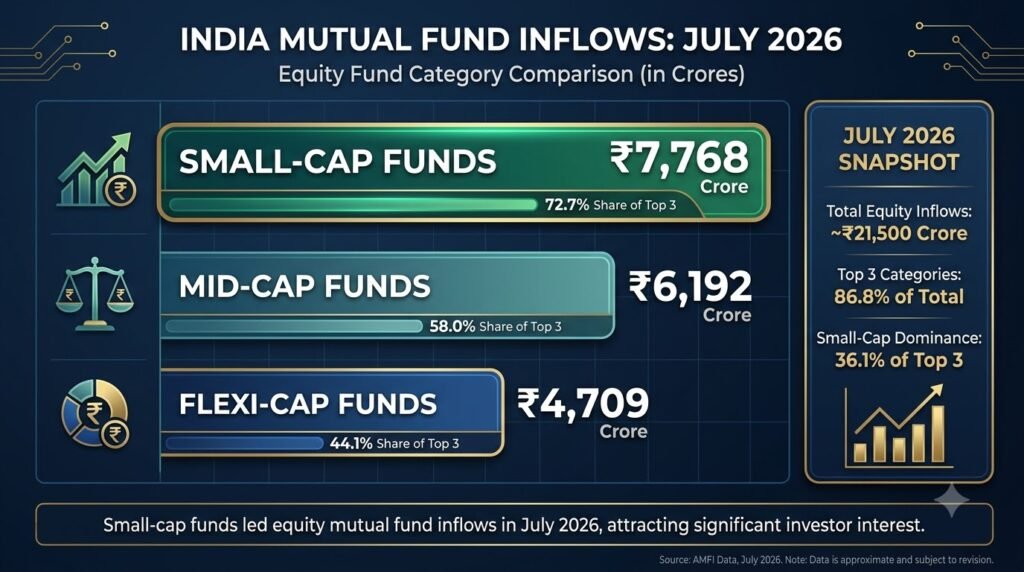
In July 2026, small-cap mutual funds received net inflows of approximately ₹7,768 crore, the highest among equity mutual fund categories. That was up from about ₹5,602 crore in June. Small-cap schemes alone attracted roughly 31% of all net equity mutual fund inflows during July.
At the end of July 2026, assets managed by the small-cap mutual fund category stood at approximately ₹4.41 lakh crore, about 24% higher than a year earlier.
Clearly, investors are interested.
But popularity and suitability are two completely different things.
So the real question is not:
“Are small-cap mutual funds good?”
The better question is:
“Are small-cap mutual funds right for me at this point in my financial journey?”
That is what we will answer.
Table of Contents
- What is a small-cap mutual fund?
- Why are small-cap funds attracting so much money in 2026?
- What does the market data tell us?
- Should you invest in small-cap mutual funds now?
- When should you hold?
- Who should avoid small-cap funds?
- Small cap vs mid cap vs flexi cap
- SIP or lump sum?
- How much small-cap exposure is enough?
- Common mistakes
- Practical investor case study
- FAQs
- Final verdict
What Is a Small-Cap Mutual Fund?
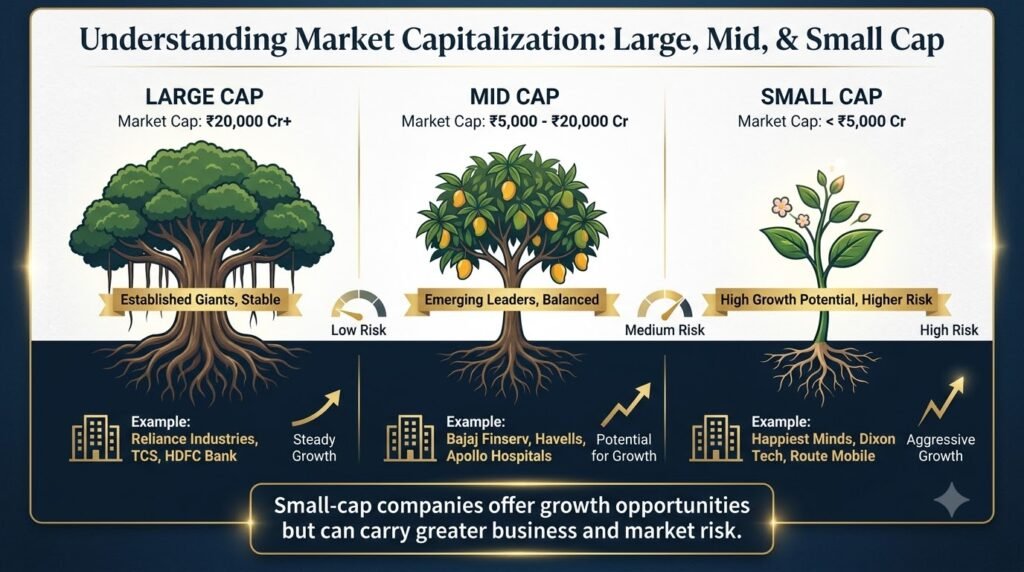
A small-cap mutual fund primarily invests in shares of relatively smaller listed companies.
Under SEBI’s current mutual-fund categorisation framework, a small-cap fund must invest at least 65% of its assets in equity and equity-related instruments of small-cap companies.
AMFI publishes the market-cap classification used by the mutual fund industry. In the current framework, companies below the large- and mid-cap universe fall into the small-cap category; AMFI updates the classification periodically based on market capitalisation data.
Simple Example
Imagine the stock market as a cricket league.
Large-cap companies are like experienced international players.
They are already established.
Mid-cap companies are talented players who have proved themselves but are still growing.
Small-cap companies are younger players.
Some may become future superstars.
Some may remain average.
And some may completely disappear from the league.
That is exactly why small caps can offer higher growth potential along with higher uncertainty.
Why Are Small-Cap Mutual Funds So Popular in 2026?
Investor interest is not imaginary.
AMFI’s July 2026 data shows:
- Small-cap fund inflows: ₹7,768 crore
- Mid-cap fund inflows: ₹6,192 crore
- Flexi-cap fund inflows: ₹4,709 crore
- Total equity mutual fund inflows: approximately ₹24,697 crore
Small-cap funds therefore attracted almost one-third of the month’s net equity-fund inflows.
But here’s where investors should become careful.
High inflows tell us what investors are buying.
They do not tell us what future returns will be.
Popularity ≠ guaranteed returns.
Small-Cap Mutual Funds: Invest, Hold or Avoid?
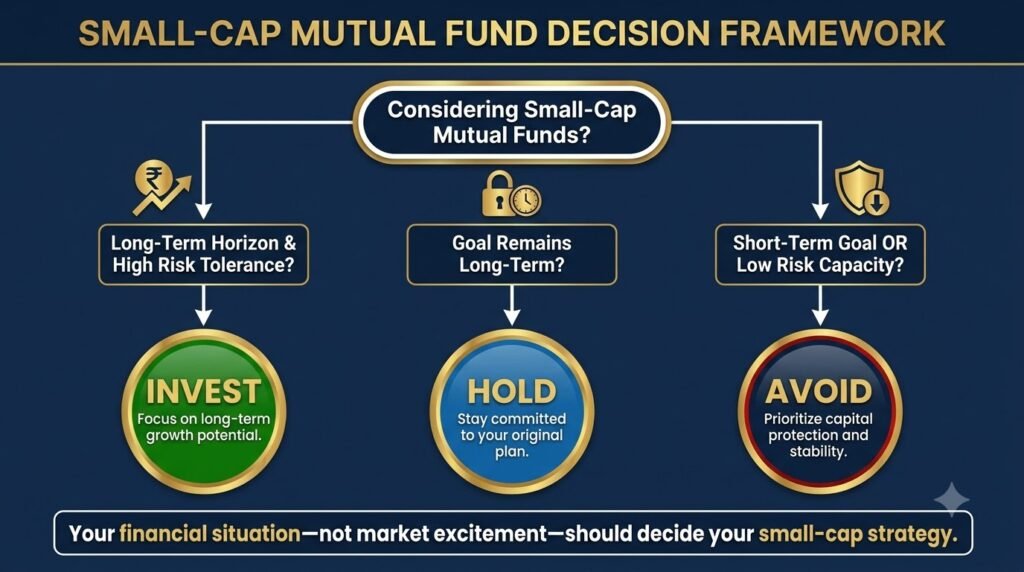
Here is the simplest framework. You can check here via SEBI Riskometer
| Your Situation | Possible Approach |
| 10+ year horizon + high risk tolerance | Consider Investing |
| Already invested + goal far away | Generally Hold / Review |
| Investing only because recent returns look attractive | Avoid Chasing |
| Money needed within 3–5 years | Usually Avoid |
| No emergency fund | Avoid for now |
| Small caps already dominate portfolio | Do not blindly add more |
| Cannot tolerate sharp portfolio falls | Avoid / Reduce exposure |
| Diversified portfolio + disciplined SIP | Potentially suitable |
Let’s understand each situation.
When Should You Consider Investing?
Small-cap mutual funds may deserve a place in your portfolio if these four conditions are satisfied.
1. Your Investment Horizon Is Long
Small companies need time to grow.
Their businesses can also face more ups and downs than mature companies.
Isliye small-cap investing ko 12-month race mat samajhiye.
Think 7–10 years or longer, especially when investing for goals such as:
- Retirement
- Financial independence
- Children’s long-term education
- Long-term wealth creation
If your goal is two years away, small caps are generally a poor place for money you cannot afford to see fluctuate sharply.
2. You Can Handle Volatility
Suppose you invest ₹2 lakh.
Six months later, your portfolio is worth ₹1.70 lakh.
What will you do?
A. Panic and sell
B. Stop your SIP
C. Keep checking NAV every morning
D. Continue according to your financial plan
If A, B or C feels likely, excessive small-cap exposure may not suit you.
Risk tolerance is not what you say when markets are rising.
Risk tolerance is how you behave when your portfolio is falling.
3. Your Core Portfolio Is Already Diversified
Small caps should not automatically become your entire equity portfolio.
A beginner’s first priority should usually be building a diversified foundation.
Think of your portfolio like a house.
A diversified core is the foundation.
Small caps are an additional floor.
Foundation banne se pehle third floor banana smart planning nahi hai.
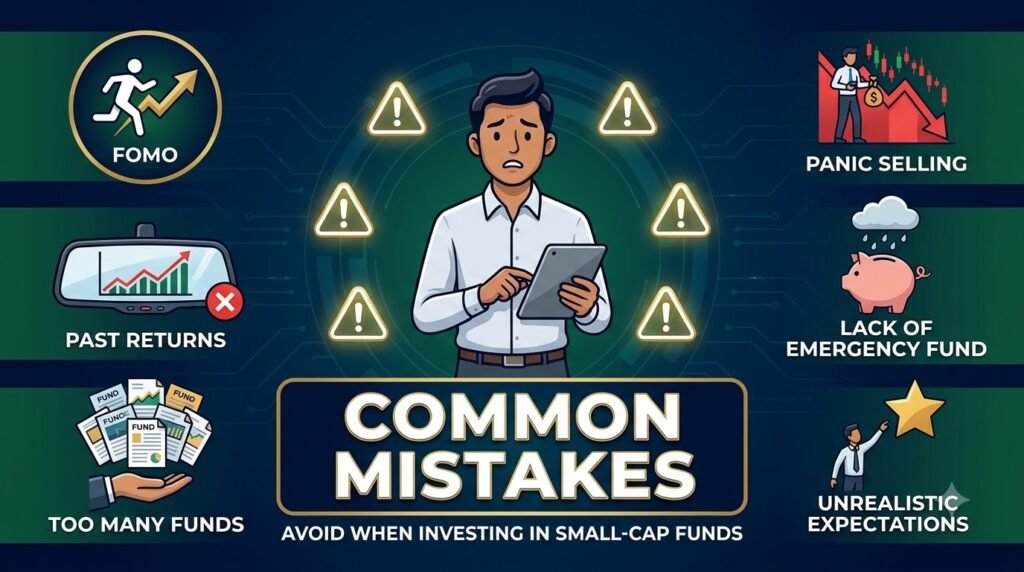
4. You Are Investing for a Goal, Not Because of FOMO
Ask yourself:
“If nobody were talking about small caps on YouTube or Instagram, would I still make this investment?”
If the answer is no, you may be reacting to FOMO instead of following an investment plan.
Already Investing? Should You Hold Your Small-Cap Fund?
For a long-term investor, a market correction alone is not necessarily a reason to exit.
Instead, review these questions:
Has your financial goal changed?
If no, don’t change the portfolio merely because markets became uncomfortable.
Has your time horizon changed?
Someone who needed the money after 15 years but now needs it after two years has a different risk problem.
Has your small-cap allocation become too large?
Suppose your planned allocation was modest, but a strong rally pushed small caps into a disproportionately large share of your equity portfolio.
That is a rebalancing question, not a “market crash prediction” question.
Has the fund itself changed materially?
Look beyond one-year returns.
Review:
- Investment strategy
- Portfolio concentration
- Fund manager changes
- Expense ratio
- Riskometer
- Long-term consistency
- Performance relative to an appropriate benchmark
SEBI requires mutual funds to display a Riskometer so investors can understand the level of risk associated with a scheme.
Who Should Avoid Small-Cap Mutual Funds?
1. Investors With Short-Term Goals
A house down payment due in two years?
College fees required in three years?
Wedding expenses next year?
Small caps should generally not be used as a parking place for such important near-term money.
2. Investors Without an Emergency Fund
Suppose you invest aggressively in small caps.
Three months later, you lose your job.
Now you need money.
Unfortunately, the market is also down.
You may be forced to sell at the worst possible time.
Emergency fund pehle.
Aggressive investing baad mein.
3. Investors Chasing the Best Performing Fund
A common Google search is:
“Best small-cap mutual fund for highest return.”
That question can be dangerous.
Last year’s No. 1 fund does not automatically become next year’s No. 1 fund.
Selecting a fund only from a one-year return table is like choosing a cricket player after watching one match.
4. Investors Who Want Guaranteed Returns
There is no guaranteed return in an equity mutual fund.
Small-cap funds can generate strong long-term returns.
They can also go through painful periods.
If seeing negative returns makes you lose sleep, the category may not match your risk profile.
Small Cap vs Mid Cap vs Flexi Cap
| Feature | Small-Cap Fund | Mid-Cap Fund | Flexi-Cap Fund |
| Main Exposure | Smaller companies | Mid-sized companies | Across market caps |
| Risk | Very High | High | Usually relatively diversified |
| Volatility | High | High | Depends on portfolio |
| Growth Potential | High | High | Balanced |
| Best Suited For | Aggressive long-term investors | Long-term growth investors | Core diversified equity allocation |
| Beginner Friendly | Lower | Moderate | Generally higher |
| Suggested Mindset | Satellite allocation | Growth allocation | Core allocation |
Under SEBI’s 2026 categorisation rules, small-cap and mid-cap funds must maintain at least 65% exposure to their respective market-cap segment, while flexi-cap funds maintain at least 65% in equities but can move across large-, mid- and small-cap stocks.
SIP or Lump Sum in Small-Cap Mutual Funds?
For beginners, SIP can be psychologically easier.
Why?
Because nobody knows whether today’s market level will look expensive or cheap two years from now.
With an SIP, you invest regularly.
When NAV is higher, your fixed investment buys fewer units.
When NAV is lower, it buys more units.
This does not eliminate risk or guarantee profits.
But it can reduce the temptation to constantly predict the perfect market entry.
Example: ₹5,000 Monthly SIP for 10 Years
Man lijiye aap har month ₹5,000 invest karte hain for 10 years.
Your total investment would be:
₹5,000 × 120 months = ₹6,00,000
Now look at three purely hypothetical return scenarios:
| Assumed Annual Return* | Approx. Value After 10 Years |
| 8% | ₹9.21 lakh |
| 10% | ₹10.33 lakh |
| 12% | ₹11.62 lakh |
*Illustrative mathematical assumptions only. These are not expected or guaranteed small-cap mutual fund returns.
The lesson is not “you will earn 12%”.
The lesson is:
Time + disciplined investing + compounding can matter more than trying to predict next month’s market.
How Much Should You Invest in Small Caps?
There is no universal percentage suitable for everyone.
Your allocation depends on:
- Age
- Financial goals
- Time horizon
- Income stability
- Existing portfolio
- Risk tolerance
- Ability to handle losses
For educational illustration, imagine two investors.
Investor A
Age: 26
Goal: Retirement after 30 years
Emergency fund: Ready
Debt: Under control
Existing diversified equity portfolio: Yes
Risk tolerance: High
A modest small-cap allocation may be reasonable to evaluate.
Investor B
Age: 48
Goal: Child’s education after four years
Emergency fund: Weak
Most savings already in equities
Risk tolerance: Low
Adding aggressive small-cap exposure simply because it is popular would make far less sense.
Same fund. Different investor. Completely different answer.
Indian Case Study: Rahul’s Small-Cap FOMO
Rahul is 29 and earns ₹70,000 per month.
He sees his colleague’s small-cap mutual fund showing excellent historical returns.
Rahul immediately wants to invest his entire ₹15,000 monthly SIP into a small-cap fund.
But let’s look deeper.
He has:
₹40,000 emergency savings.
₹60,000 credit-card debt.
No health insurance beyond employer coverage.
No diversified equity portfolio.
Would a small-cap fund really be his first priority?
Probably not.
A better sequence could be:
- Strengthen emergency savings.
- Clear expensive debt.
- Protect major financial risks.
- Build a diversified investment portfolio.
- Then consider whether a small-cap allocation fits his goals.
The fund isn’t the problem.
The sequence is.
Advantages of Small-Cap Mutual Funds
Higher Growth Potential
Smaller businesses may have more room to expand than already dominant companies.
Professional Fund Management
Instead of trying to identify individual small-cap stocks yourself, a professional fund manager performs research and portfolio management.
Diversification
A mutual fund spreads money across multiple companies rather than depending on one stock.
Long-Term Wealth-Creation Potential
If businesses grow successfully and valuations remain sensible, small caps can contribute meaningfully to a long-term equity portfolio.
Disadvantages and Risks
High Volatility
Small-cap prices can fluctuate significantly.
Liquidity Risk
Smaller stocks may be less liquid than large companies, making buying or selling large positions more difficult during stressed markets.
Business Risk
Smaller companies may have less diversified businesses, weaker balance sheets or greater dependence on a few products or customers.
Valuation Risk
A great company purchased at an excessive valuation can still produce disappointing investment returns.
The Nifty Smallcap 250 traded at a P/E of 34.25 as of July 31, 2026. A P/E number alone cannot tell you whether the entire segment is overvalued or undervalued, but it is one factor investors should evaluate instead of assuming recent popularity guarantees future returns.
Expert Tips Before Investing
Check the Riskometer. Understand what “very high risk” actually means for your behaviour.
Read the Scheme Information Document. Understand where the fund can invest.
Check portfolio concentration. Look at top holdings and sector exposure.
Don’t obsess over the latest winner. Consistency matters more than rankings.
Decide your asset allocation before selecting the fund.
Review annually, not daily.
Keep expectations realistic.
And most importantly:
Never invest in an asset simply because other people are making money from it.
FAQs
1. Are small-cap mutual funds good in 2026?
They can be suitable for aggressive long-term investors, but strong industry inflows should not be treated as a signal that returns are guaranteed.
2. Is now the right time to invest in small-cap mutual funds?
There is no universally perfect entry point. Your horizon, asset allocation and risk tolerance matter more than predicting the next market move.
3. Are small-cap mutual funds risky?
Yes. Small-cap schemes generally carry significant equity-market and company-specific risk. Check the scheme’s current Riskometer before investing.
4. How long should I stay invested?
For high-volatility equity categories such as small caps, investors should generally think long term rather than expecting predictable short-term returns.
5. Is SIP better for small-cap mutual funds?
SIP can help investors invest regularly and avoid trying to perfectly time the market, but it does not guarantee profits.
6. Can small-cap mutual funds give negative returns?
Yes. Equity mutual funds can deliver negative returns over some periods.
7. Should beginners invest in small caps?
Beginners should first understand diversification, risk, emergency funds and asset allocation. A small-cap fund should not automatically become the first or only investment.
8. Should I stop my small-cap SIP during a market crash?
A market fall alone is not sufficient reason. Review your goal, horizon, financial capacity and asset allocation before making a decision.
9. Is one small-cap fund enough?
One diversified fund may provide exposure to many stocks. Adding multiple funds only for the sake of quantity can create portfolio overlap.
10. Are small-cap funds better than flexi-cap funds?
Neither category is universally better. Flexi-cap funds have freedom across market capitalisations, while small-cap funds maintain concentrated exposure to smaller companies under SEBI’s categorisation framework.
Conclusion
Small-cap mutual funds in 2026 are attracting serious investor attention.
And yes, India’s long-term economic growth can create opportunities for smaller businesses.
But investing success does not come from identifying the most exciting category.
It comes from building a portfolio you can actually hold through difficult markets.
Man lijiye small caps fall after you invest.
Will you panic?
Or will you understand why you invested in the first place?
That question matters more than whether the Nifty Smallcap index rises next month.
Invest only when the category matches your goals, time horizon and risk tolerance.
Because wealth creation is not about finding the fastest-moving investment.
It is about staying disciplined for long enough to let compounding work.
Important Risk Disclosure
This article is for financial education only and does not constitute investment advice or a recommendation to buy or sell any mutual fund scheme. Mutual fund investments are subject to market risks. Past performance does not guarantee future returns. Read the scheme-related documents and evaluate your financial goals, risk tolerance and investment horizon before investing.
Also, Read:–> Small Cap vs Mid Cap vs Large Cap Mutual Funds in 2026: Where Is Investor Money Going?
Should You Increase SIP During Market Correction? ₹5,000 Example Explained