
You can invest in bonds online in India through a regulated Online Bond Platform Provider, or OBPP. Before investing, verify the platform’s registration through SEBI/NSE/BSE, understand the bond issuer’s credit quality, check coupon rate, Yield to Maturity, maturity date and liquidity, and read the offer documents carefully. A regulated platform reduces platform-related risks but does not guarantee that the bond issuer will repay your money.
Introduction
A few years ago, buying individual bonds in India was not particularly beginner-friendly.
Today, you can open an app or website, see corporate bonds offering different coupon rates and maturities, complete KYC and invest online.
Simple lagta hai.
But there is one dangerous misunderstanding:
“If a bond is available on a regulated online platform, it must be safe.”
That is not necessarily true.
SEBI regulates how Online Bond Platform Providers operate, and it has specifically warned investors against dealing with unregistered online bond platforms. But the underlying bond can still carry default, interest-rate, liquidity and other risks.
So the right question is not simply:
“Which bond gives the highest return?”
It is:
“How can I understand what I am buying and whether the additional return is worth the additional risk?”
This guide explains exactly that.
Table of Contents
- What is a bond?
- What is an OBPP?
- What changed in SEBI’s 2026 OBPP rules?
- Which investments can an OBPP offer?
- How to verify whether a bond platform is registered
- How to invest in bonds online step by step
- Coupon vs YTM explained
- Six risks you should check
- How to analyse a bond before investing
- Bond vs FD vs debt mutual fund
- Common beginner mistakes
- Who should invest in individual bonds?
- FAQs
- Conclusion
What Is a Bond?
A bond is basically a loan given by you to an issuer.
Instead of borrowing money only from a bank, a company, government or another eligible entity can raise money by issuing bonds.
You invest money.
The issuer promises to pay interest according to the terms of the bond and repay the principal on maturity.
SEBI’s investor education material describes a bond in similar terms: an investor lends money to a government or corporation for a predetermined period and may receive coupon payments during the investment period.
Simple Example
Man lijiye a company issues a bond with:
| Detail | Example |
|---|---|
| Face Value | ₹1,00,000 |
| Coupon Rate | 8.5% |
| Maturity | 3 years |
| Coupon Frequency | Annual |
If the coupon is calculated on ₹1,00,000, the annual coupon is:
₹1,00,000 × 8.5% = ₹8,500
You may receive ₹8,500 annually, subject to the bond’s terms, and the principal is due at maturity.
But remember:
A promise to repay is not the same as a guarantee of repayment.
If the issuer gets into serious financial trouble, bondholders can face delays, restructuring or losses.
What Is an Online Bond Platform Provider or OBPP?
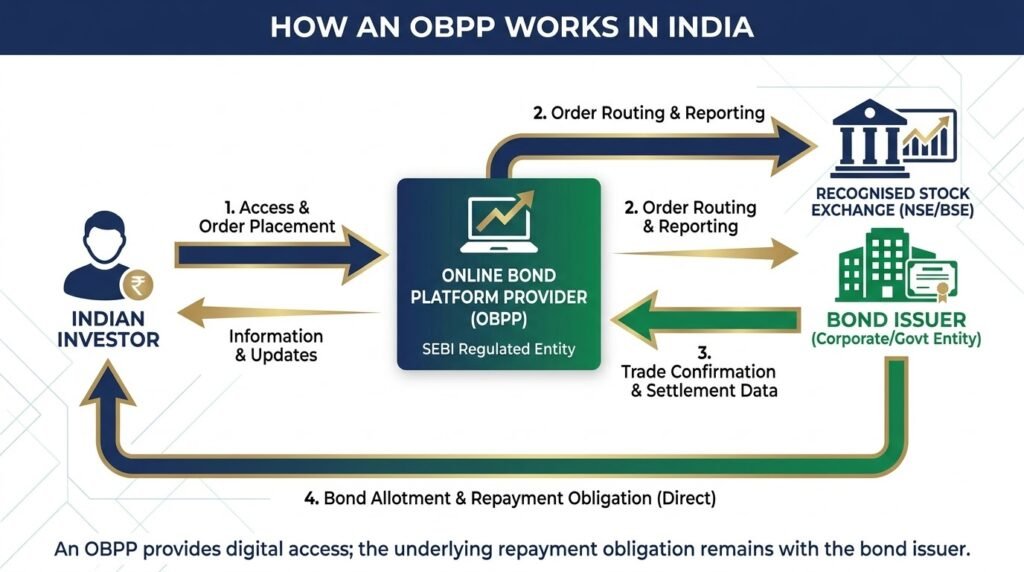
An Online Bond Platform Provider (OBPP) is an entity operating an online platform through which eligible debt securities and other permitted products can be offered to investors.
Under SEBI’s regulatory architecture, an entity seeking to act as an OBPP must operate within the prescribed framework, including stock-broker/debt-segment and recognised-stock-exchange requirements. The framework originated in 2022 and has subsequently been updated.
Think of an OBPP as the digital marketplace/interface through which you access bonds.
But the platform and the bond issuer are two different things.
Platform Risk vs Bond Risk
Suppose you buy a bond issued by XYZ Finance through a regulated platform.
bond risks explained by SEBI
There are two separate questions:
Question 1: Is the platform operating under the proper regulatory framework?
Question 2: Can XYZ Finance actually repay its debt?
SEBI regulation helps with the first question.
It does not automatically answer the second.
That distinction is extremely important.
What Changed in SEBI’s Latest OBPP Rules?
SEBI issued a new circular on 14 August 2026, effective immediately, modifying parts of the OBPP framework.
Three changes are particularly relevant.
1. IFSCA-Regulated Products Can Be Offered
OBPPs may offer products, securities or services regulated by the International Financial Services Centres Authority, subject to applicable rules.
Where IFSCA-regulated investments are offered, they must be clearly identified as international or overseas instruments.
Applicable FEMA, Overseas Investment and Liberalised Remittance Scheme requirements also continue to matter.
Beginner takeaway: Foreign/international products appearing inside a bond platform should not be confused with ordinary domestic bonds.
2. Certain 54EC Bonds Can Be Offered
The new framework permits OBPPs to offer specified bonds under Section 54EC of the Income-tax Act, 1961 or the corresponding provision referenced under the Income-tax Act, 2025.
These are specialised tax-related instruments.
For eligible Section 54EC investments, the Income Tax Department states that qualifying capital gains from specified land/building transfers may receive exemption subject to conditions, including investment timelines and limits. The current Section 54EC text provides an aggregate ₹50 lakh investment ceiling under the specified conditions and a five-year redemption period for qualifying bonds issued from April 2018 onward.
Importantly, SEBI requires OBPPs offering these bonds to make specific disclosures.
And for these tax-specific instruments, the August 2026 circular says the grievance mechanism lies with the issuer rather than SEBI.
3. Compliance Officer Requirement Updated
The August 2026 circular also updates the OBPP compliance-officer requirement.
The entity must have a compliance officer under the applicable SEBI Stock Brokers framework, with prescribed certification requirements.
For investors, this is mainly a regulatory-governance change rather than something that changes how you choose a bond.
What Can an OBPP Offer?
Under the amended framework, permitted categories include:
- Listed debt securities
- Listed municipal debt securities
- Listed securitised debt instruments
- Eligible securities proposed to be listed through public offerings
- Listed Government Securities
- State Development Loans
- Treasury Bills
- Listed Sovereign Gold Bonds
- Certain products regulated by SEBI, RBI, IRDAI, IFSCA or PFRDA
- Eligible Section 54EC/tax-specific bonds
This doesn’t mean every OBPP will necessarily offer every category.
How to Check Whether an Online Bond Platform Is Registered
This should be your first safety check.
Do not rely only on the logo displayed on the platform.
Do not rely on an influencer saying, “SEBI registered hai.”
SEBI maintains an official page linking to lists of OBPPs registered with NSE and BSE. SEBI has also explicitly cautioned investors to verify registration before transacting and to avoid unregistered online bond platforms.
Before investing:
- Find the legal entity name of the platform.
- Check the official SEBI OBPP directory.
- Verify the relevant NSE/BSE registration listing.
- Confirm that the website/app belongs to the same legal entity.
- Avoid transferring money based on WhatsApp, Telegram or unofficial payment instructions.
Golden rule: Never use the word “regulated” as a substitute for due diligence.
How to Invest in Bonds Online in India: Step-by-Step
Step 1: Define Why You Want Bonds
Don’t start with yield.
Start with your goal.
For example:
“₹3 lakh ki amount mujhe approximately 3 years baad chahiye.”
Now you can compare investments based on:
- Time horizon
- Risk tolerance
- Cash-flow needs
- Liquidity requirements
Step 2: Choose a Properly Registered Platform
Verify the OBPP using official regulatory/exchange records.
This step helps protect you from unregistered operators, which SEBI has specifically warned investors about.
Step 3: Complete KYC and Required Account Setup
Depending on the transaction route and instrument, you may need standard securities-market onboarding requirements such as PAN, bank details, KYC and a demat account.
Read the platform’s onboarding documents rather than clicking “I Agree” blindly.
Step 4: Shortlist Bonds by Risk—Not Yield
Suppose you see:
Bond A: 7.5%
Bond B: 9%
Bond C: 11.5%
Beginner instinct:
“11.5% best hai.”
Wrong framework.
A higher yield may be compensation for higher credit risk, poorer liquidity, longer duration or other structural risks.
SEBI itself explains that lower-rated issuers may offer higher yields because investors are taking greater risk.
Step 5: Read the Bond Details
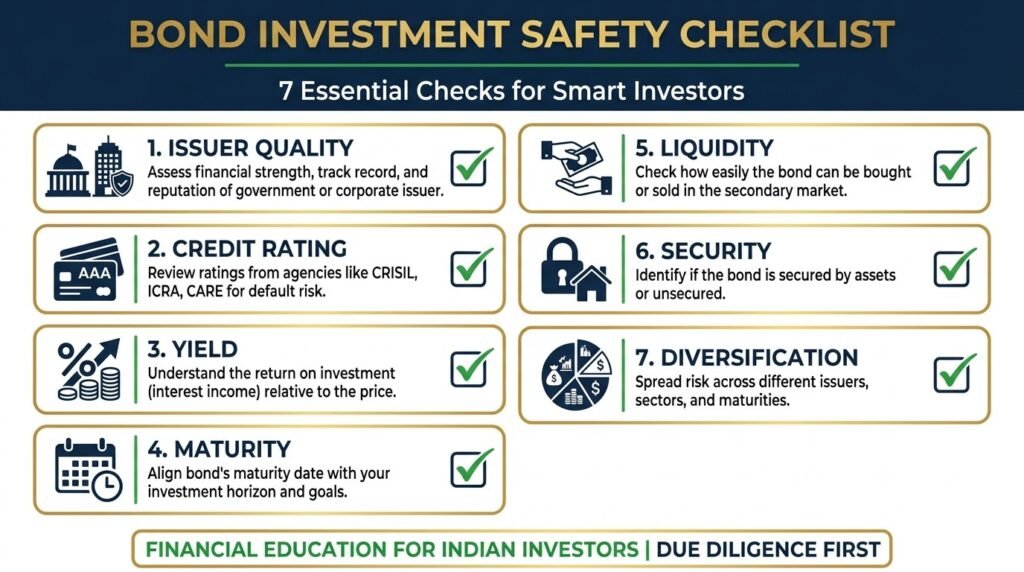
Before clicking Invest, understand at least:
| Check | What to Ask |
| Issuer | Who owes you money? |
| Credit Rating | What is the current rating? |
| Coupon | What interest is promised? |
| YTM | What is the approximate yield at current price? |
| Maturity | When is principal scheduled to return? |
| Security | Secured or unsecured? |
| Payment Frequency | Monthly, quarterly, annual? |
| Call/Put Features | Can issuer/investor redeem early? |
| Liquidity | Can you realistically sell early? |
| Documents | Have you read key disclosures? |
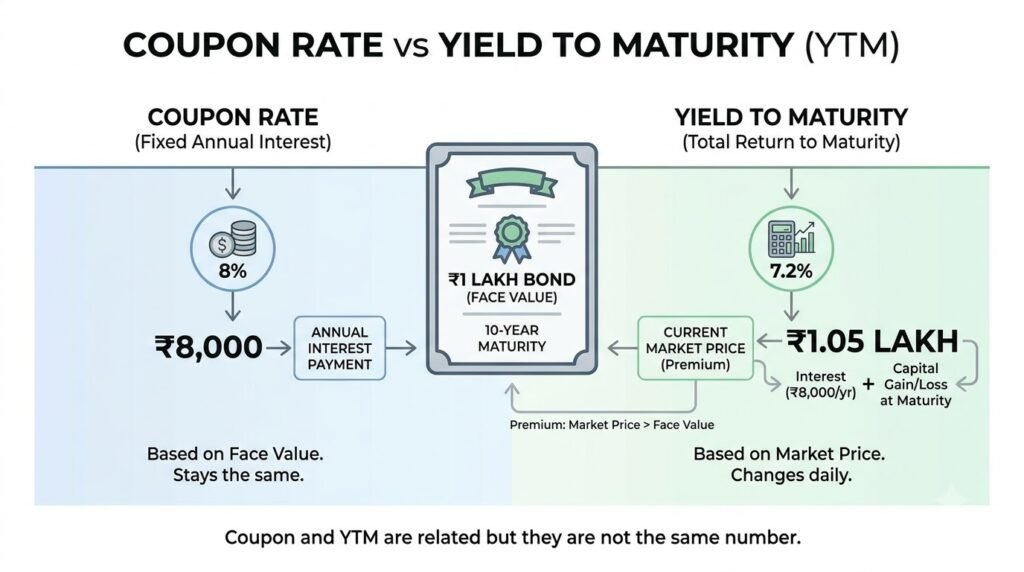
Coupon Rate vs YTM: Don’t Confuse Them
This is one of the most common beginner mistakes.
Imagine a bond has:
Face value = ₹1,00,000
Coupon = 8.5%
Annual coupon = ₹8,500.
But suppose you buy that bond in the secondary market for ₹98,000.
Your simple coupon-to-purchase-price relationship becomes:
₹8,500 ÷ ₹98,000 ≈ 8.67%
But even that is not automatically the YTM.
Yield to Maturity also considers factors such as the purchase price, redemption amount, remaining maturity and timing of cash flows.
So whenever a platform displays:
Coupon: 8.5%
YTM: 9.1%
don’t assume one of them is wrong.
They measure different things.
Six Risks You Must Understand Before Buying Bonds
1. Default Risk
The issuer may fail to pay interest or principal.
This is the biggest risk in many corporate bonds.
2. Credit Rating Risk
A credit rating is useful—but it is not permanent.
Ratings can change.
SEBI specifically advises investors not to rely solely on a credit rating.
3. Interest Rate Risk
When market interest rates rise, prices of existing fixed-rate bonds can fall.
This matters especially if you need to sell before maturity.
4. Liquidity Risk
A bond may technically be listed but still have very few buyers.
Aapko emergency mein sell karna ho, lekin buyer attractive price par available na ho.
That can create a loss.
5. Call Risk
Some bonds allow the issuer to redeem them before their stated maturity date.
SEBI identifies call risk as one of the risks bond investors should understand.
6. Concentration Risk
Putting ₹5 lakh into one company’s bond is not diversification simply because it is a “fixed-income” investment.
Issuer diversification matters.
Does “Secured Bond” Mean Safe?
No.
A secured bond has identified security/collateral arrangements according to its terms.
But that does not mean:
“Default hua toh 100% money immediately mil jayega.”
Recovery can depend on asset value, legal processes, priority of claims and several other factors.
Treat security as one layer of protection—not a guarantee.
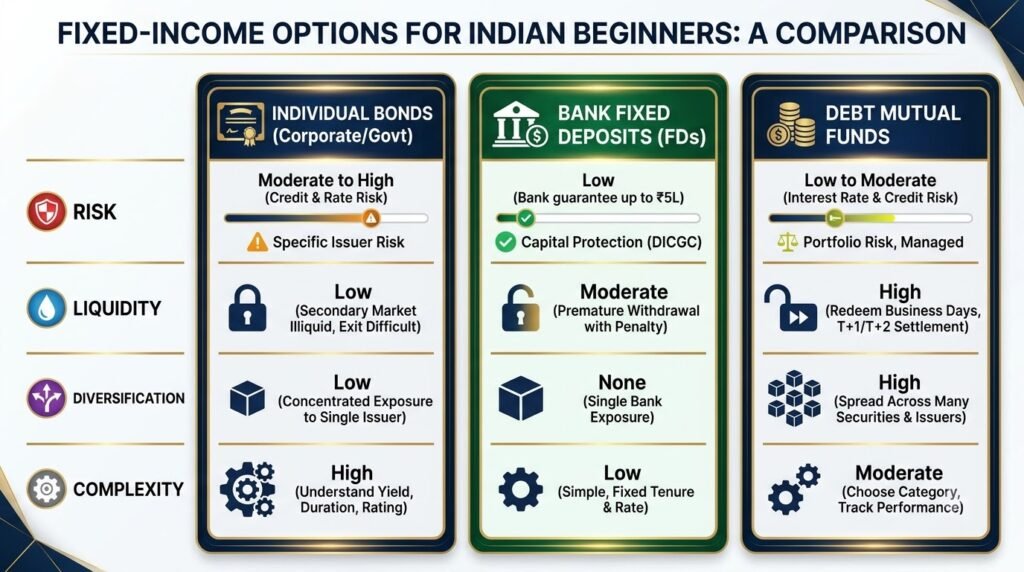
Bond vs FD vs Debt Mutual Fund
| Feature | Individual Bond | Bank FD | Debt Mutual Fund |
| Return Visibility | Relatively high if held and issuer performs | High | Market-linked |
| Credit Risk | Depends on issuer | Depends on bank + applicable deposit framework | Spread across portfolio |
| Liquidity | Can be weak | Usually available with conditions | Generally easier redemption |
| Diversification | You create it | Usually issuer-level | Built into portfolio |
| Expertise Needed | Medium–High | Low | Low–Medium |
| Price Fluctuation | Yes | Usually not visible like market securities | Reflected in NAV |
| Best For | Investors who understand issuer risk | Simplicity seekers | Diversified debt exposure |
Individual bonds can be useful.
But they are not automatically better than FDs or debt funds simply because the displayed yield is higher.
Example: How a Beginner Should Think
Man lijiye Rahul has ₹3 lakh.
He sees a corporate bond offering approximately 10% yield.
Instead of investing the full ₹3 lakh immediately, Rahul asks:
- Do I understand the issuer?
- What is the credit rating?
- Why is the yield higher?
- Can I hold until maturity?
- What happens if I need money early?
- How much of my total portfolio will this bond represent?
- Do I already have an emergency fund?
That is investing.
Simply clicking the highest yield is yield-chasing.
Expert Tips for Safer Bond Investing
For beginners, use a simple rule:
Issuer first. Yield second.
Check whether you can explain the company’s business and repayment capacity in two sentences.
Match maturity with your goal.
Avoid money needed for emergencies.
Understand whether you’re buying in a primary issue or secondary market.
Check the latest credit rating rather than an old screenshot.
Read the relevant offer document/information memorandum and key disclosures.
Compare the YTM with safer alternatives.
If the difference seems unusually attractive, ask:
“What risk am I being paid to take?”
Are Bonds Safe?
Some bonds can have relatively low credit risk; others can carry substantial risk.
Government securities and corporate bonds should not be treated as one single risk category.
Similarly, an AAA-rated corporate bond and a much lower-rated bond should not be viewed as equivalent simply because both are called “bonds”.
SEBI lists default, interest-rate, liquidity and call risks among the important risks bond investors should understand.
Key Takeaways
1. Verify the platform first.
Use SEBI/NSE/BSE records.
2. A regulated platform does not guarantee the bond.
3. Don’t invest based only on yield.
4. Understand coupon and YTM separately.
5. Check issuer quality and credit rating.
6. Don’t ignore liquidity risk.
7. Match bond maturity to your financial goal.
8. Diversify rather than concentrating everything in one issuer.
9. The August 2026 SEBI rules expanded what OBPPs can offer, including specified IFSCA-regulated products and tax-specific bonds.
Conclusion
Online bond platforms have made fixed-income investing significantly more accessible to Indian retail investors.
That is a positive development.
But easier access should not lead to easier decision-making.
A bond showing 10% or 11% yield is not automatically “better” than one offering 7.5%.
Return is the visible number. Risk is the number you have to investigate.
So before investing:
Verify the platform.
Understand the issuer.
Read the disclosures.
Check the rating.
Understand YTM.
Assess liquidity.
Diversify.
And invest only when you can explain why the extra return is worth the extra risk.
That approach is far more valuable than chasing whichever bond happens to display the biggest percentage today.
Risk Disclosure
This article is for financial education only and is not investment, tax or legal advice. Bond prices and credit quality can change, and issuers can default. SEBI registration or exchange registration of an intermediary should not be interpreted as a guarantee of returns or repayment. Evaluate your financial situation and consult an appropriately qualified professional where required.
FAQ
1. Can beginners invest in bonds online in India?
Yes. Retail investors can access eligible bonds through regulated routes including Online Bond Platform Providers. Beginners should first understand credit, liquidity and interest-rate risks.
2. What is an OBPP?
OBPP stands for Online Bond Platform Provider. It is an entity operating an online bond platform under SEBI’s regulatory framework.
3. How do I check if a bond platform is registered?
Check the official SEBI OBPP page and the corresponding NSE/BSE registration records.
4. Is every bond on an OBPP safe?
No. Regulation of the platform does not guarantee repayment by the issuer.
5. What is the difference between coupon and YTM?
Coupon is the contractual interest rate calculated according to the bond terms. YTM estimates the return based on purchase price, future cash flows and maturity if its assumptions are met.
6. Can I lose money in bonds?
Yes. Default, interest-rate changes and liquidity conditions can cause losses.
7. What does AAA rating mean?
AAA generally represents a high credit-quality rating within the rating agency’s scale, but ratings remain opinions and can change.
8. Are secured bonds risk-free?
No. Security or collateral can provide additional protection but does not eliminate default or recovery risk.
9. Can I sell a bond before maturity?
Potentially, if a market/buyer exists. The selling price may be above or below your purchase price.
10. What changed in SEBI’s August 2026 OBPP rules?
The changes include permitting specified IFSCA-regulated offerings, allowing eligible tax-specific bonds including 54EC instruments, and modifying compliance-officer requirements.
Also Read:- Small-Cap Mutual Funds 2026: Invest, Hold or Avoid?