
Understand EPF Withdrawal Rules 2026, the 75% withdrawal rule, 25% minimum balance, 12-month waiting period, withdrawal limits and online process.
Introduction
Your EPF account may look like money sitting in your name.
But it is not designed to work like a normal savings account.
EPF is primarily a retirement corpus, and the Employees’ Provident Fund Scheme, 2026 has changed how members can access that money.
The most talked-about change is the “75% withdrawal rule.”
But saying “you can simply withdraw 75% of your PF whenever you want” is an oversimplification.
The actual rule is more interesting.
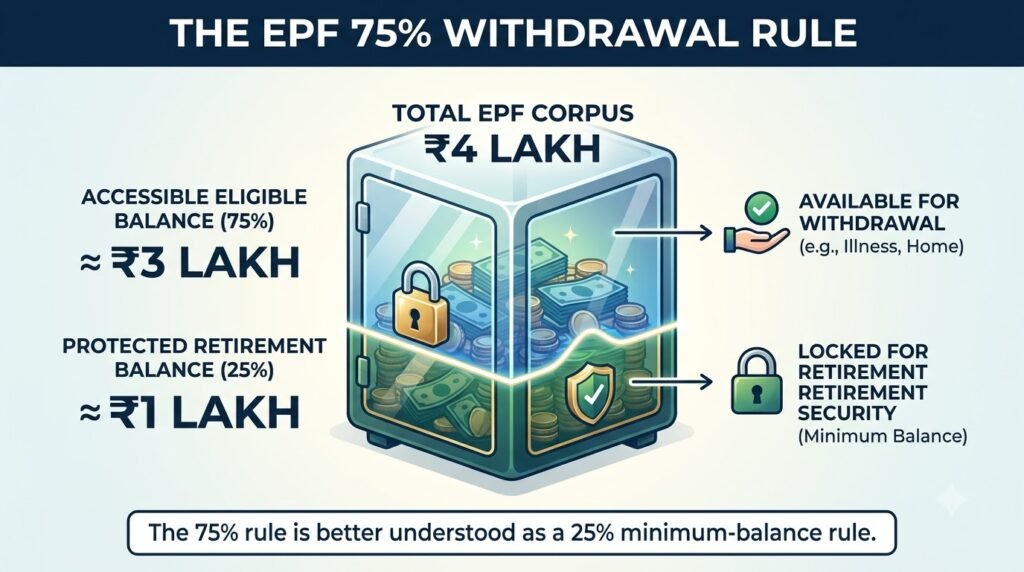
Under the new scheme, a member generally has to preserve a Minimum Balance equal to 25% of aggregate contributions, including the employee share, employer share and interest. The remaining amount becomes the Eligible Member Balance for partial withdrawals, subject to the applicable purpose and conditions.
Another major change affects people who leave their jobs.
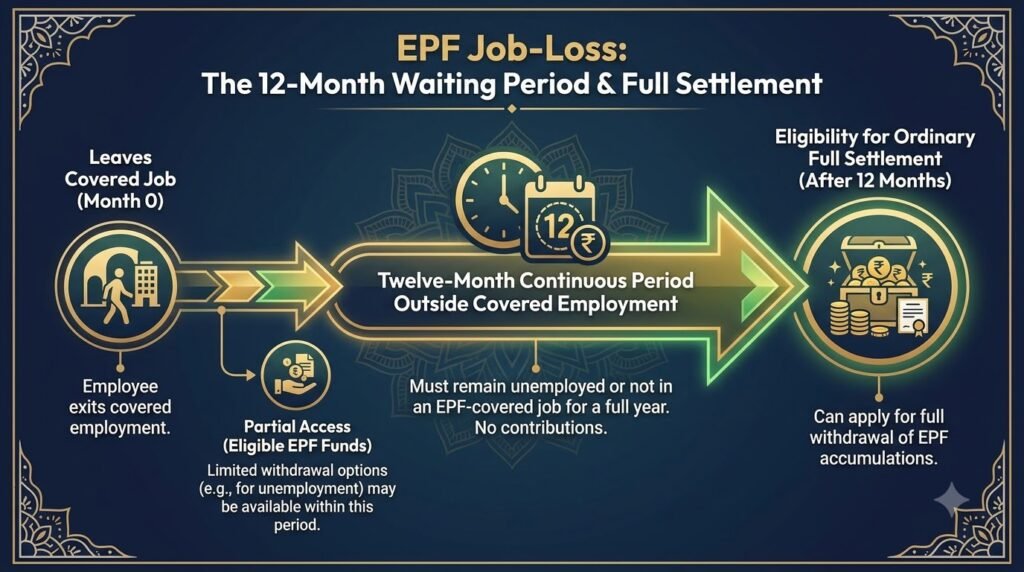
For an ordinary premature full EPF settlement, the new scheme generally requires the member to remain outside covered employment for at least 12 continuous months before applying.
Samajhte hain simple examples ke saath.
Table of Contents
- What changed under EPF Withdrawal Rules 2026?
- What is the new 75% withdrawal rule?
- What is Eligible Member Balance?
- Partial withdrawal rules in 2026
- EPF withdrawal after losing or leaving a job
- When can you withdraw 100% of EPF?
- How to apply online
- Example with ₹4 lakh EPF balance
- Why EPFO wants you to retain 25%
- Advantages and disadvantages
- Common mistakes
- FAQs
What Changed Under EPF Withdrawal Rules 2026?
The Gazette notification dated 29 June 2026 introduced the Employees’ Provident Fund Scheme, 2026, replacing the older 1952 scheme subject to the transition provisions. The new scheme states that it comes into force on publication in the Official Gazette.
One objective is simplification.
Earlier, members had to navigate multiple withdrawal provisions depending on medical needs, marriage, education, housing and other circumstances.
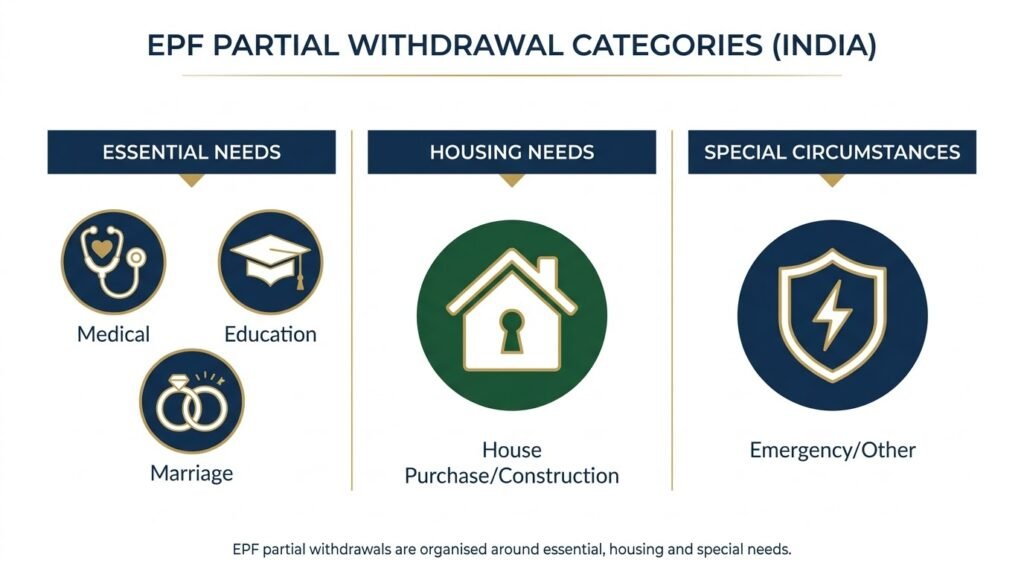
The government had previously announced that these complex provisions would be consolidated into three broad groups:
Essential Needs: illness, education and marriage
Housing Needs: purchase, construction, loan repayment, renovation, etc.
Special Circumstances: other specified financial situations.
The 2026 scheme now sets out a unified partial-withdrawal framework.
What Is the EPF 75% Withdrawal Rule?
This is the part most people misunderstand.
The EPF Scheme 2026 defines a Minimum Balance that must normally remain after a partial withdrawal.
That minimum balance equals 25% of aggregate contributions credited for the member, including employee contribution, employer contribution and interest up to the withdrawal date.
The remaining amount is called your:
Eligible Member Balance
In simple terms:
Eligible Member Balance = Amount standing to your EPF credit − Required Minimum Balance
You may withdraw up to 100% of this Eligible Member Balance where the relevant withdrawal rule permits it.
That is why the rule is commonly described as a 75% withdrawal rule.
Important Note
Do not blindly calculate:
EPF passbook balance × 75%
The legal definition refers to 25% of aggregate contributions plus interest, and previous withdrawals can affect your situation.
The amount shown as eligible on the EPFO system should therefore be treated as more reliable than a rough manual calculation.
Example: You Have ₹4 Lakh in EPF
Man lijiye your EPF accumulation for this simplified example is:
| Particular | Amount |
|---|---|
| Total EPF accumulation | ₹4,00,000 |
| Approx. 25% protected balance | ₹1,00,000 |
| Approx. Eligible Member Balance | ₹3,00,000 |
| Maximum potential partial withdrawal | Up to ₹3,00,000 |
So ₹3 lakh can represent roughly 75% of a ₹4 lakh corpus.
But ₹1 lakh remains invested for retirement.
This example assumes a straightforward account without complications from previous withdrawals.
Partial EPF Withdrawal Rules 2026
The new rules are significantly easier to understand.
For most categories, the minimum membership period is 12 months.
| Purpose | Minimum Membership | Maximum Withdrawal | Frequency |
| Illness — self/family | 12 months | Up to 100% of Eligible Member Balance | No separate cap specified in Para 46(2)(a) |
| Education — self/family | 12 months | Up to 100% of Eligible Member Balance | Up to 10 times |
| Marriage — self/family | 12 months | Up to 100% of Eligible Member Balance | Up to 5 times |
| House/site/construction | 12 months | Up to 100% of Eligible Member Balance | Up to 5 times |
| Home-loan repayment | 12 months | Up to 100% of Eligible Member Balance | Within housing limit |
| House renovation/improvement | 12 months | Up to 100% of Eligible Member Balance | Within housing limit |
| Special circumstances | 12 months | Up to 100% of Eligible Member Balance | Up to 2 times per financial year |
The minimum partial-withdrawal amount under Paragraph 46 is ₹1,000.
Interestingly, the scheme also provides that a member exiting employment before completing 12 months of membership can make a partial withdrawal up to the Eligible Member Balance available on the withdrawal date.
What Happens If You Lose or Leave Your Job?
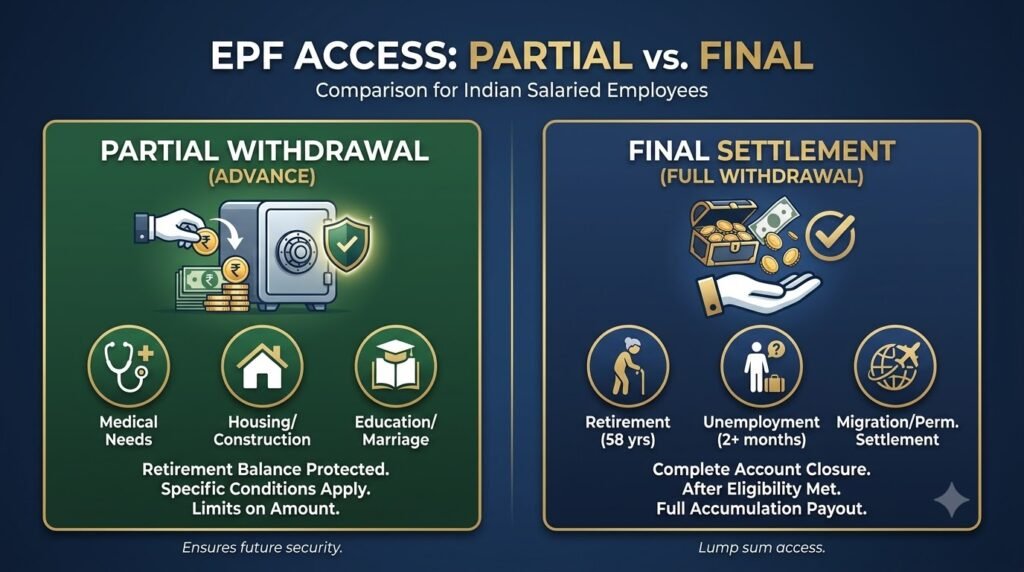
This is where partial withdrawal and final settlement must not be confused.
The government had explained the reform using a simple unemployment example: a member could access roughly 75% while the remaining 25% would protect the retirement corpus until the full-settlement condition was satisfied.
Under the notified 2026 scheme, ordinary full settlement after ceasing covered employment generally requires you to have not been employed in another establishment covered by the Code for at least 12 continuous months immediately before applying.
So:
Leaving a job does not necessarily mean you should close your EPF account.
Agar aap kuch months mein new job join karne wale hain, transferring your EPF rather than emptying it can often make more financial sense.
When Can You Withdraw 100% of Your EPF?
The 25% minimum-balance rule primarily matters for partial withdrawals.
The new scheme separately permits full withdrawal in specified circumstances.
These include:
- Retirement after attaining age 55
- Permanent and total incapacity for work
- Permanent migration from India or taking employment abroad
- Certain retrenchment cases
- Voluntary retirement under an eligible arrangement
- Other specified closure, transfer or employment-termination situations
- Ordinary cessation from covered employment after satisfying the applicable 12-month waiting condition
The detailed circumstances are contained in Paragraph 49 of the EPF Scheme, 2026.
There is also a specific exception to the ordinary waiting-period requirement for a female member resigning for the purpose of getting married.
EPF Withdrawal Process in 2026
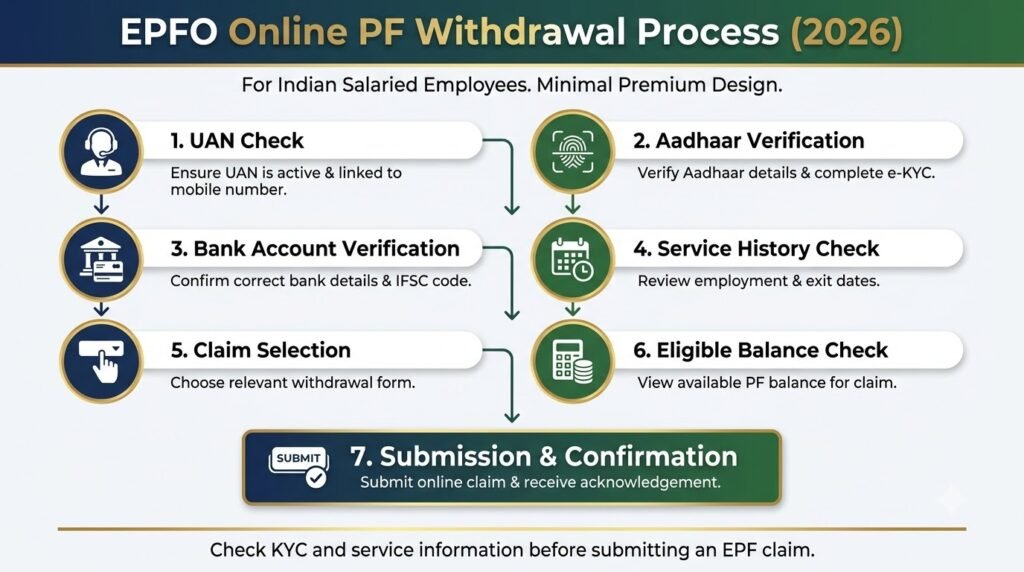
The process is increasingly digital.
The new scheme specifically provides for partial-withdrawal applications through the designated portal. It also requires members to furnish information including UAN, Aadhaar, an Aadhaar-seeded bank account and PAN.
Goto Link:- https://unifiedportal-mem.epfindia.gov.in/memberinterface/
Step 1: Check Your UAN Details
Ensure your UAN is active and your personal information is correct.
Your name, date of birth and other details should match your KYC records.
Step 2: Verify Aadhaar and Bank Account
Make sure the correct bank account is linked and active.
Galat bank account ya KYC mismatch claim delay ka common reason ho sakta hai.
Step 3: Check Your Service History
Verify your joining date, exit information and previous employment.
The 2026 scheme requires members to furnish past employment or PF membership particulars through the prescribed portal.
Step 4: Choose the Relevant Withdrawal Claim
Choose whether you are applying for:
Partial withdrawal, or
Final settlement.
For a partial withdrawal, select the applicable purpose.
Step 5: Check Eligible Amount
Do not assume the amount is simply 75% of the number in your passbook.
Check the amount permitted by the EPFO system after applying the Minimum Balance rules.
Step 6: Authenticate and Submit
EPFO’s online-claims guidance uses UAN credentials and Aadhaar-based authentication for eligible online claims. Portal screens can change as EPFO upgrades its technology, so follow the current instructions displayed during filing.
Payment of an approved partial withdrawal may be made to the permitted bank/co-operative bank or post-office account under the scheme.
Why Does EPFO Want You to Keep 25%?
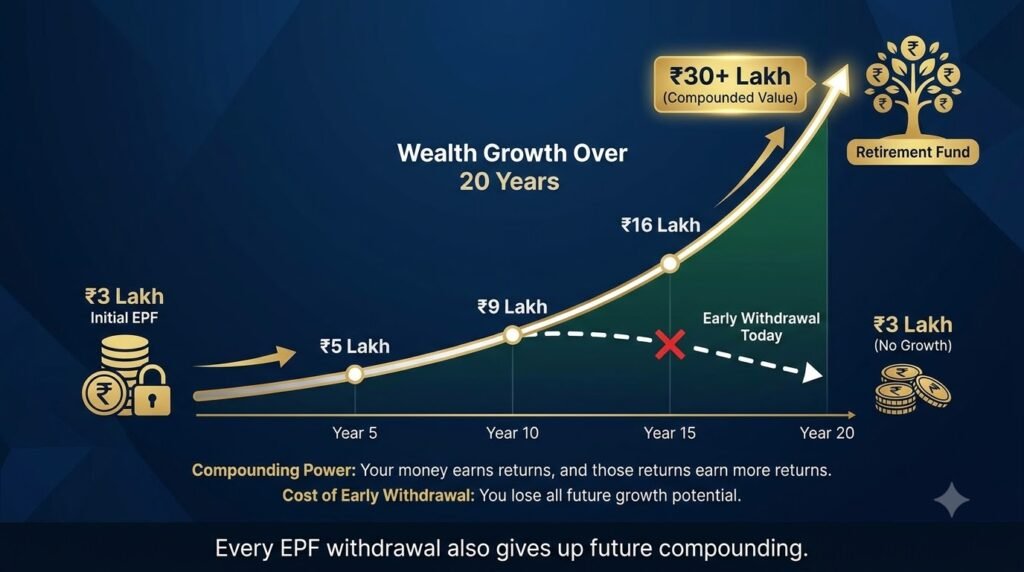
Because withdrawing retirement money has a hidden cost.
It is called lost compounding.
The approved EPF interest rate for FY 2025–26 is 8.25% per annum.
Suppose you withdraw ₹3 lakh.
If that ₹3 lakh instead remained invested for 20 years and hypothetically earned 8.25% every year:
₹3,00,000 could grow to approximately ₹14.64 lakh.
That calculation is only illustrative because EPF interest rates are declared periodically and can change.
Still, the lesson is important.
Aaj ₹3 lakh withdraw karna sirf ₹3 lakh ka decision nahi hai.
You may also be giving up decades of future compounding.
Advantages of the New EPF Withdrawal Rules
The biggest advantage is simplicity.
Members now have clearer withdrawal categories and a common concept of Eligible Member Balance.
The 12-month membership condition for major partial-withdrawal categories is also easier to understand than multiple different service requirements.
Education withdrawals can be taken up to 10 times, marriage withdrawals up to five times, and housing-related withdrawals up to five times during membership under the relevant provisions.
At the same time, the protected balance reduces the chance that a member repeatedly empties their retirement savings.
Disadvantages and Concerns
The biggest concern is the 12-month waiting period for ordinary full settlement after leaving covered employment.
Someone facing prolonged unemployment may feel that one year is a long time to wait for the entire corpus.
The 25% minimum balance also means PF cannot always be treated as unrestricted emergency cash.
From a retirement-planning perspective, however, this restriction is intended to preserve a minimum long-term corpus.
Common Beginner Mistakes
Mistake 1: Thinking 75% is always exactly 75% of the current passbook balance
The actual rule uses Eligible Member Balance and Minimum Balance definitions.
Mistake 2: Confusing a partial withdrawal with final settlement
They have different eligibility conditions.
Mistake 3: Closing EPF every time you change jobs
Usually, transferring the existing PF balance preserves continuity and compounding.
Mistake 4: Ignoring KYC before an emergency
Check Aadhaar, UAN, bank information and service details before you actually need the money.
Mistake 5: Treating EPF like a savings account
EPF’s primary purpose is retirement.
Use withdrawals carefully.
Frequently Asked Questions
Can I withdraw 75% of my EPF in 2026?
For partial withdrawals, the new framework generally requires a 25% Minimum Balance to be preserved. Up to 100% of the remaining Eligible Member Balance may be withdrawn where the relevant category allows it.
Can I withdraw my complete PF immediately after resigning?
Not under the ordinary final-settlement provision. Generally, you must remain outside employment covered by the Code for at least 12 continuous months before applying for full settlement. Specific exceptions exist.
Is there a 12-month service requirement for partial withdrawal?
Yes, 12 months of total membership applies to major categories such as illness, education, marriage, housing and special circumstances, subject to the specific exception for a member exiting before completing 12 months.
How many times can EPF be withdrawn for education?
Up to 10 times during membership under the education provision.
How many times can I withdraw EPF for marriage?
Up to five times during membership.
Can EPF be withdrawn for buying a house?
Yes. Eligible housing purposes include buying a house or flat, buying land for construction, construction, home-loan repayment and specified renovation or improvement.
Is the 25% balance rule applicable to retirement withdrawal?
The protected Minimum Balance applies to partial withdrawals. Paragraph 49 separately allows full settlement in eligible situations such as retirement and specified other circumstances.
What is the current EPF interest rate?
The Government approved 8.25% for FY 2025–26. EPF interest rates are determined periodically and should not be assumed to remain unchanged in future years.
Conclusion
The EPF Withdrawal Rules 2026 try to balance two competing needs.
Liquidity today and retirement security tomorrow.
You can access a significant part of your accumulated EPF for genuine needs, but the new framework protects a minimum portion of the corpus from repeated withdrawals.
That restriction may feel inconvenient during a financial emergency.
But remember what EPF is designed for.
It is not merely money sitting in an account.
It is your future salary being saved for a time when your monthly salary may stop.
Isliye EPF withdrawal ko “Can I withdraw?” se nahi, “Should I withdraw?” se evaluate kijiye.
That one question can make a huge difference to your retirement corpus.
Risk & Information Disclosure
This article is for financial education and general information only. EPFO portal procedures, tax treatment and administrative instructions can change. Always verify your eligibility and available withdrawal amount through the official EPFO portal before submitting a claim.
Also Read:- Small Cap vs Mid Cap vs Large Cap Mutual Funds in 2026
Step-Up SIP: ₹1,000 Extra Every Year Can Create Powerful Wealth