
Introduction
SIP during market correction is one of the biggest questions investors ask when the stock market starts falling. Should you continue your SIP, stop it, or increase it? Let us understand this with a simple ₹5,000 example.
YouTube thumbnails are shouting, “Big Opportunity!”
And suddenly you have one question:
“Should I increase my SIP now?”
This question is especially relevant in 2026. As of August 6, the BSE Sensex had declined nearly 8% during the year, creating anxiety as well as “buy the dip” discussions among investors.
At the same time, Indians have continued investing systematically. AMFI reported SIP contributions of ₹31,781 crore in June 2026, showing how important SIPs have become in household investing.
But increasing your SIP just because the market is falling is not automatically a smart move.
Sahi question yeh nahi hai: “Market kitna gira?”
The better question is:
“Does my financial situation allow me to invest more without taking unnecessary risk?”
Let us understand this from the beginning.
What Is a Market Correction?
A market correction generally refers to a meaningful decline from a recent market high.
You do not need to obsess over the exact percentage.
For a long-term investor, the important point is that equity markets do not move upward in a straight line.
Prices rise.
Then they fall.
Sometimes they remain flat for months.
Then they recover.
Volatility is part of equity investing.
A falling market may feel like something has gone wrong, but short-term price declines do not automatically mean your long-term financial plan has failed.
That distinction matters.
What Happens to Your SIP When Markets Fall?
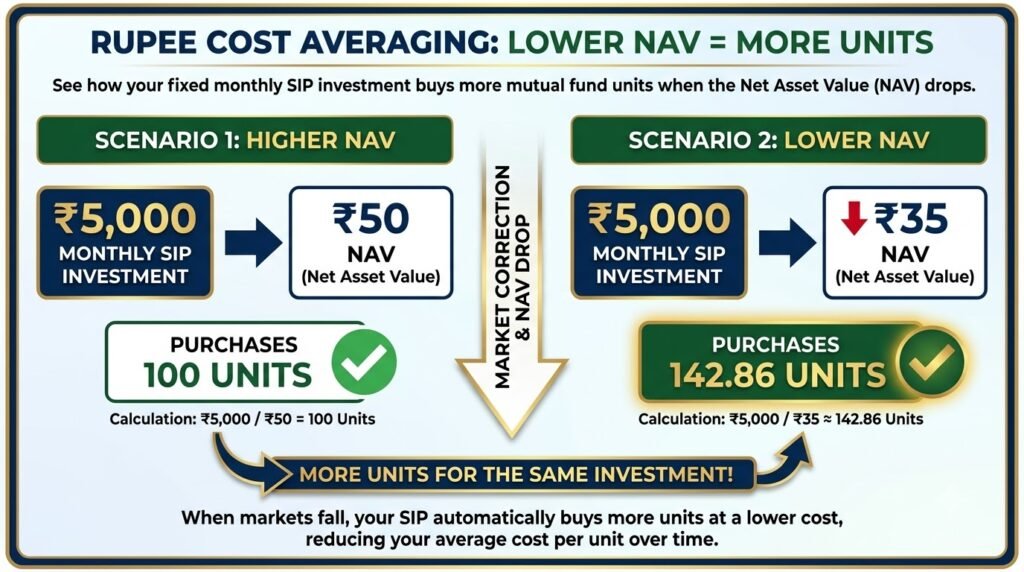
A SIP invests a fixed amount periodically into a mutual fund.
NSE describes SIP as a mutual-fund facility that allows investors to invest regularly, similar in concept to putting a fixed amount into a recurring deposit.
The difference is that the mutual fund NAV changes.
Suppose you invest:
₹5,000 every month.
If the NAV is ₹50:
₹5,000 ÷ ₹50 = 100 units
Now suppose the market falls and NAV becomes ₹40:
₹5,000 ÷ ₹40 = 125 units
Your investment amount did not change.
But you received 25 additional units because the price was lower.
This is one of the basic advantages of systematic investing.
₹5,000 SIP Example During a Market Correction
Man lijiye aap har month ₹5,000 invest karte hain.
For simplicity, imagine the NAV behaves like this:
| Month | SIP Amount | NAV | Units Purchased |
|---|---|---|---|
| January | ₹5,000 | ₹50 | 100.00 |
| February | ₹5,000 | ₹48 | 104.17 |
| March | ₹5,000 | ₹45 | 111.11 |
| April | ₹5,000 | ₹40 | 125.00 |
| May | ₹5,000 | ₹35 | 142.86 |
| June | ₹5,000 | ₹40 | 125.00 |
Total invested: ₹30,000
Approximate units accumulated: 708.14
Notice what happened.
When NAV dropped from ₹50 to ₹35, your ₹5,000 SIP bought significantly more units.
This is why stopping a suitable long-term equity SIP only because prices have fallen can work against the purpose of systematic investing.
However, this example does not mean that lower NAV guarantees future profit.
NAV can fall further.
A fund can underperform.
Your chosen category may be unsuitable.
Markets can remain weak longer than expected.
The example simply explains how regular investing behaves when prices fluctuate.
Should You Increase SIP During a Market Correction?
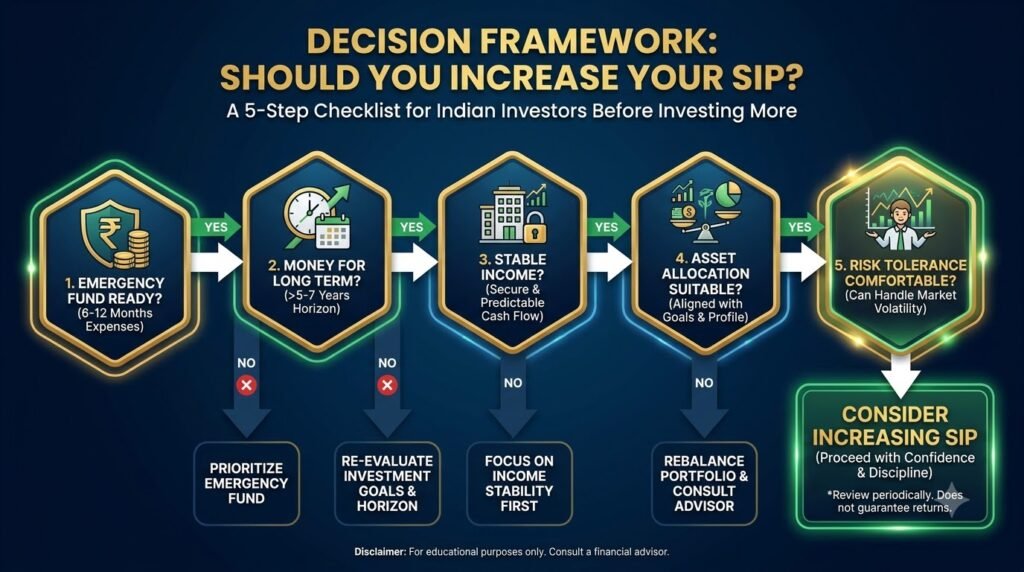
For many long-term investors, increasing SIP during a correction can make sense.
But only under the right conditions.
Use this five-point test.
1. Your Emergency Fund Is Already Ready
Before increasing an equity SIP, ideally keep money available for unexpected expenses.
For example:
Job loss
Medical emergency
Major home repair
Family emergency
Suppose you have ₹1 lakh sitting in your bank account and suddenly decide to invest ₹80,000 because the market has fallen.
Then an emergency arrives next month.
You may be forced to redeem investments at exactly the wrong time.
Emergency money ka kaam return generate karna nahi hai.
Its job is to remain available.
2. You Do Not Need the Money Soon
Equity is generally unsuitable for money you know you will need in the near term.
Imagine you need ₹4 lakh for college fees 12 months from now.
The market falls 15%.
You invest that money hoping for a recovery.
Instead, the market falls another 15%.
Now your financial goal is at risk.
A correction does not transform short-term money into long-term money.
3. Your Income Is Stable
Increasing a SIP creates an additional recurring commitment.
If your monthly SIP is ₹10,000 and you increase it to ₹15,000, ask:
Can I comfortably maintain ₹15,000 even if the market remains weak for another year?
If yes, the increase may be sustainable.
If not, an emotional “buy the dip” decision can become a financial burden.
4. Your Asset Allocation Allows More Equity
This is one of the most important points.
Suppose your target allocation is:
70% Equity
30% Debt
But because you have aggressively invested during every market dip, your portfolio becomes:
90% Equity
10% Debt
You did not merely “buy cheap.”
You changed the risk profile of your financial plan.
Current expert commentary around market corrections similarly emphasizes reviewing asset allocation and rebalancing, rather than blindly changing funds or SIP amounts.
Your portfolio should be driven by goals—not excitement.
5. Your Investment Horizon Is Long
The longer your investment horizon, the more time you potentially have to ride through market cycles.
Someone investing for retirement 20 years away faces a different situation from someone saving for a house down payment two years away.
Same market.
Same correction.
Completely different investment decision.
Normal SIP vs Increased SIP: Simple Illustration
Suppose two investors start with the same portfolio.
Investor A
Continues ₹5,000 monthly SIP.
Investor B
Can genuinely afford more and increases the SIP to ₹7,500 during a weak market.
Over six months:
Investor A invests:
₹5,000 × 6 = ₹30,000
Investor B invests:
₹7,500 × 6 = ₹45,000
If NAVs remain depressed, Investor B will naturally acquire more units because ₹15,000 additional capital was invested.
But there is no free lunch.
If the market continues falling, Investor B will also see a larger rupee decline on the larger equity investment.
So the decision is not:
“Will increasing SIP make more money?”
The decision is:
“Can I responsibly allocate more money to equity for my long-term goal?”
That is a much healthier framework.
Is a Step-Up SIP Better Than Waiting for a Crash?
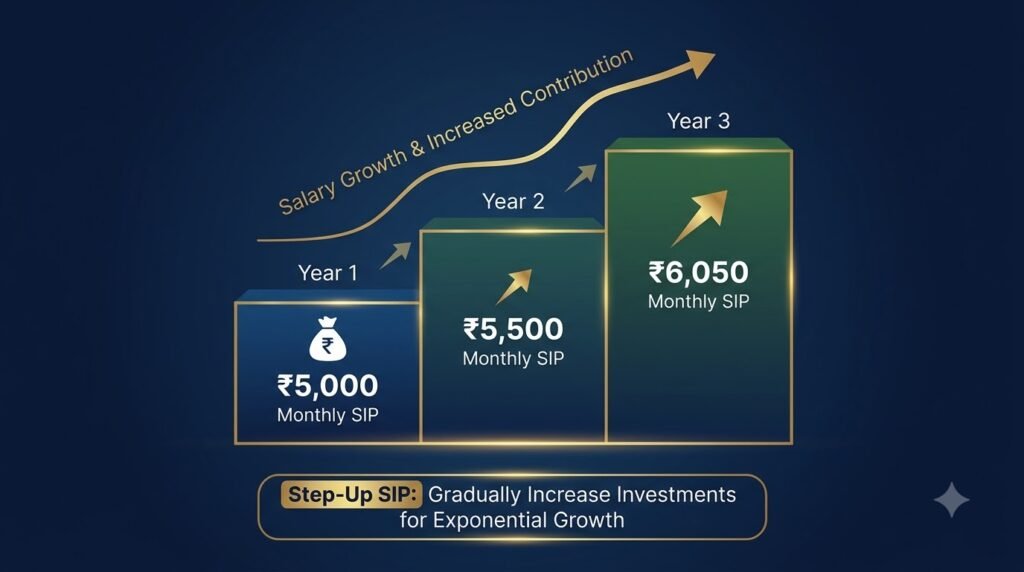
For many salaried investors, a planned Step-Up SIP can be more practical than trying to predict corrections.
For example:
Year 1: ₹5,000/month
Year 2: ₹5,500/month
Year 3: ₹6,050/month
That represents roughly a 10% annual increase.
Your SIP grows with your income instead of changing every time the Sensex moves.
This removes a difficult problem:
market timing.
Waiting with cash for the “perfect crash” sounds easy in hindsight.
In real time, nobody knows whether a 10% fall will become a 20% fall—or whether the recovery has already started. Recent investor education coverage has highlighted precisely this difficulty with attempting to wait for the perfect market bottom.
Consistency is usually easier to execute than prediction.
When You Should NOT Increase Your SIP
Do not increase your SIP merely because social media says markets are cheap.
Avoid increasing it if:
- You do not have an emergency fund.
- You have expensive debt such as credit-card balances.
- Your income is uncertain.
- The money is required for a short-term goal.
- Your equity allocation is already above your target.
- You are increasing SIP because of FOMO.
- You cannot tolerate seeing the additional investment temporarily fall.
- You do not understand the mutual fund you are investing in.
A falling NAV does not automatically make every fund attractive.
A poorly chosen fund does not become suitable simply because it is cheaper than last month.
Should You Stop SIP When the Market Falls?
A market decline alone is usually not a logical reason to stop a SIP designed for a suitable long-term goal.
Think about the contradiction.
When NAV is high, you invest.
When NAV falls and your SIP starts getting more units, you stop.
Then when headlines become positive and NAV rises again, you restart.
That behaviour converts SIP investing into emotional market timing.
But there are legitimate reasons to stop or change a SIP.
For example:
Your financial goal has changed.
Your asset allocation needs restructuring.
The scheme no longer fits your strategy.
Your cash flow has deteriorated.
You selected the fund incorrectly.
You require the money for a higher-priority need.
The difference is important.
Stop because your financial plan changed—not because a red screen scared you.
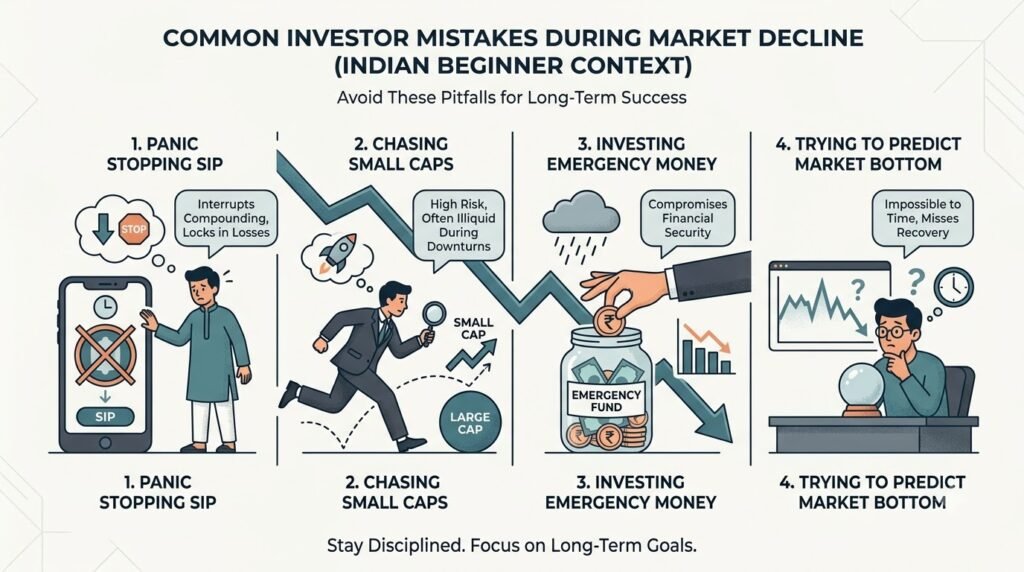
Common Beginner Mistakes During a Market Correction
Mistake 1: Stopping SIP Because Returns Turn Negative
Temporary negative returns are possible in equity investing.
If you cannot tolerate temporary declines, your equity allocation may be too aggressive.
Mistake 2: Starting Five New Mutual Funds
More funds do not automatically create better diversification.
You may simply create portfolio overlap.
Mistake 3: Moving Everything Into Small-Cap Funds
Small-cap funds can experience much sharper volatility.
Higher return potential does not mean guaranteed higher returns.
Mistake 4: Investing Emergency Cash
Liquidity and safety should come before chasing a correction.
Mistake 5: Trying to Find the Exact Bottom
A market bottom becomes obvious only after it has passed.
Mistake 6: Increasing SIP Beyond Your Monthly Capacity
A SIP you can sustain for years is more useful than an aggressive SIP you cancel after three months.
Frequently Asked Questions
1. Is SIP good during a market correction?
A SIP can be useful during volatile markets because a fixed investment buys more units when NAVs are lower and fewer units when NAVs are higher. However, returns are not guaranteed.
2. Should I double my SIP when the market crashes?
Not automatically. Double your SIP only if the higher amount fits your income, emergency fund, goals, risk tolerance and asset allocation.
3. Should I stop SIP if my mutual fund return becomes negative?
Temporary negative returns alone are not sufficient reason to stop a long-term SIP. Review whether the fund and asset allocation still suit your goal.
4. What happens to SIP when the market falls?
Your fixed SIP amount generally buys more mutual-fund units when the scheme’s NAV falls.
5. Is lump sum better than SIP during a correction?
Neither is universally better. A lump sum involves immediate market exposure; a SIP or staggered investment spreads deployment over time. Your cash-flow situation and risk tolerance matter.
6. What is a Step-Up SIP?
A Step-Up SIP periodically increases your SIP contribution—for example, increasing ₹10,000 per month by 10% each year.
7. Should beginners invest more during a crash?
Beginners should first establish their goals, emergency fund, asset allocation and risk tolerance. A market crash itself should not dictate the investment amount.
8. Can the market fall after I increase my SIP?
Yes. Nobody knows the market bottom in advance. Markets may continue falling after you invest.
9. Which mutual fund is best during a correction?
There is no universally best fund for every correction. Fund selection should depend on your goal, time horizon, asset allocation and risk profile.
10. Does SIP guarantee profit?
No. SIP is an investment method, not a return guarantee. Mutual-fund investments are subject to market risks.
Conclusion
A market correction can feel uncomfortable.
But discomfort does not automatically mean danger—and falling prices do not automatically mean opportunity either.
For a disciplined long-term investor, the best response is usually to return to the financial plan.
Ask:
Do I have an emergency fund?
Is my income stable?
Is this money truly long term?
Does my asset allocation permit more equity?
Can I maintain the higher SIP comfortably?
If the answers are yes, increasing your SIP may be reasonable.
If the answers are no, there is nothing wrong with simply continuing your existing investment—or prioritising another financial goal.
Market ko predict karna zaroori nahi hai.
Building a process you can follow through both bull and bear markets is far more important.
Risk Disclosure
This article is for financial education and general information only. It is not personalised investment advice or a recommendation to buy, sell or increase investment in any particular mutual-fund scheme. Mutual-fund investments are subject to market risks. Read scheme-related documents carefully and consider consulting a SEBI-registered investment adviser where personalised advice is required.
Also Read:- Is ₹5,000 Monthly SIP Enough to Build ₹1 Crore? Realistic Calculation and Timeline
Should You Stop SIP During Market Correction? What Actually Happens to Your Units