
Introduction
Gold occupies a special place in Indian households.
For our parents and grandparents, gold was not merely an investment. It represented financial security, family tradition and emergency savings.
Even today, gold is purchased during weddings, Akshaya Tritiya, Dhanteras and festivals. But the way Indians invest in gold is changing.
Earlier, buying gold usually meant visiting a jewellery shop.
Today, an investor can choose between:
- Physical gold
- Gold ETFs
- Digital gold
- Gold mutual funds
- Electronic Gold Receipts
- Sovereign Gold Bonds available in the secondary market
This creates an important question:
Should you buy a Gold ETF, physical gold or digital gold in 2026?
All three provide exposure to gold prices, but they are not equally safe, regulated, tax-efficient or cost-effective.
In this article, we will compare them using simple Indian examples and real calculations.
Why Is Gold Investment Popular in 2026?
Gold investment demand in India remained strong during 2026.
According to the World Gold Council, Indian gold demand increased by 10% year-on-year in the first quarter of 2026. Investment demand rose faster than jewellery demand, and Indian Gold ETFs recorded their strongest-ever quarter. Gold ETF holdings reached approximately 115 tonnes by the end of March 2026.
This shows an important shift.
Indian investors are no longer buying gold only as jewellery. They are increasingly using gold as a financial asset.
However, a rising gold price does not mean investors should put all their money into gold.
Gold can experience long periods of weak returns and sharp price fluctuations. It should normally be treated as a portfolio-diversification asset—not as a guaranteed wealth-creation product.
What Is Physical Gold?
Physical gold means gold that you can directly hold.
It includes:
- Gold jewellery
- Gold coins
- Gold bars
- Gold biscuits
When you buy physical gold, you own the metal directly.
There is no mutual-fund company, digital platform or demat account between you and your gold.
Physical Gold Example
Man lijiye aap ₹1 lakh ka gold coin purchase karte hain.
The coin is stored in your home locker or bank locker. When you need money, you can sell it to a jeweller or bullion dealer.
The value you receive will depend on:
- Current gold price
- Purity
- Dealer’s buyback rate
- Testing deductions
- Local demand
- Applicable transaction costs
Advantages of Physical Gold
1. Direct ownership
You physically possess the asset.
Unlike a financial product, you are not dependent on an investment platform to access it.
2. Cultural and personal use
Physical gold can be worn, gifted or used in family functions.
A Gold ETF cannot replace jewellery at a wedding.
3. No demat account required
Anyone can buy coins, bars or jewellery without opening an investment account.
4. Recognisable emergency asset
Gold is widely accepted by jewellers and lenders.
It may also be used as collateral for a gold loan, subject to the lender’s terms.
Disadvantages of Physical Gold
1. Making charges
Jewellery making charges can significantly increase the purchase cost.
These charges are generally not recovered when the jewellery is sold.
2. GST creates an immediate cost
Gold purchases generally attract GST. Therefore, the market price of gold must rise before you recover your initial tax and transaction costs.
3. Storage and theft risk
Physical gold may require:
- A bank locker
- Home security
- Insurance
- Safe transportation
4. Purity risk
A buyer must verify whether the gold is:
- 18 karat
- 22 karat
- 24 karat
- BIS hallmarked
5. Resale deductions
The jeweller may deduct:
- Melting charges
- Testing charges
- Stone value
- Dealer margin
- Making charges already paid
6. Jewellery is not an efficient investment product
Jewellery combines two things:
- Gold value
- Design and craftsmanship cost
You may enjoy the design, but the making charge does not necessarily appreciate with the gold price.
What Is a Gold ETF?
A Gold ETF, or Gold Exchange-Traded Fund, is a mutual-fund scheme that invests primarily in gold and gold-related instruments.
Its units are listed on a stock exchange.
You can buy and sell these units through your demat and trading account, similar to shares.
SEBI recognises Gold ETFs as regulated gold-related products. Gold ETF schemes generally invest the overwhelming majority of their assets in gold or permitted gold-related instruments, with a limited portion held for liquidity requirements.
Gold ETF Example
Man lijiye aap ₹1 lakh ka gold exposure chahte hain.
Instead of purchasing a coin and storing it in a locker, you purchase units of a Gold ETF through your broker.
The fund house purchases and stores the underlying gold through its custodian.
Your holding appears in your demat account.
Advantages of Gold ETFs
1. SEBI-regulated structure
Gold ETFs are mutual-fund products governed by the securities-market regulatory framework.
This provides disclosures, fund-accounting requirements, custody arrangements and investor-protection mechanisms that ordinary digital gold does not provide.
2. No physical storage problem
You do not need to worry about:
- Theft
- Home storage
- Locker access
- Gold purity testing
3. Lower entry friction than jewellery
There are no jewellery making charges.
However, investors still bear brokerage, bid-ask spread, fund expenses and tracking difference.
4. Exchange liquidity
Gold ETF units can ordinarily be bought and sold during market hours.
Liquidity can vary across ETFs, so investors should examine trading volume and bid-ask spreads before purchasing.
5. Transparent market price
The ETF price is visible on the exchange.
The AMC also publishes the scheme’s NAV and portfolio information.
6. Better for portfolio rebalancing
Suppose your target allocation is:
- 60% equity
- 30% debt
- 10% gold
If gold rises sharply and becomes 15% of your portfolio, you can sell a portion of the ETF relatively easily and restore your target allocation.
Doing this with jewellery is far more difficult.
Disadvantages of Gold ETFs
1. Demat and trading account required
You need a broker and demat account.
Investors without demat access may find a gold fund-of-funds easier, although that may involve an additional layer of expenses.
2. Expense ratio
The fund charges annual expenses.
These expenses gradually reduce the scheme’s returns relative to the underlying gold price.
3. Tracking error and tracking difference
A Gold ETF may not perfectly match domestic gold-price returns because of:
- Expense ratio
- Cash holdings
- Transaction costs
- Timing differences
- Portfolio-management factors
4. Bid-ask spread
The purchase price and selling price may differ.
An ETF with low trading activity can have a wider spread.
5. Market price can temporarily differ from NAV
You may purchase the ETF at a premium or sell it at a discount to its indicative value.
Therefore, investors should use limit orders rather than blindly using market orders, especially in less-liquid ETFs.
What Is Digital Gold?

Digital gold allows users to purchase small quantities of gold through an app or online platform.
The platform or its gold-service partner claims to purchase corresponding physical gold and store it in a vault on the customer’s behalf.
Users may generally:
- Buy small amounts
- Sell through the platform
- Accumulate gold over time
- Request delivery, subject to conditions and charges
The greatest attraction is convenience.
Some platforms allow purchases starting from extremely small amounts.
Digital Gold Example
Man lijiye aap every week ₹100 ka digital gold purchase karte hain.
The app displays your accumulated gold balance in grams or rupee value.
You do not directly hold the gold unless you request physical delivery.
Advantages of Digital Gold
1. Very small minimum purchase
Digital gold makes it easy to begin with ₹10, ₹50 or ₹100, depending on the platform.
2. Convenient purchase process
It can often be purchased through a familiar payment or fintech app.
3. No immediate home-storage requirement
The service provider arranges vault storage, subject to the provider’s contractual structure.
4. Physical-delivery option
Some providers allow the user to convert the accumulated balance into coins or bars.
Delivery, minting and minimum-quantity conditions may apply.
Disadvantages of Digital Gold
1. Digital gold is not regulated by SEBI
This is the most important difference.
In November 2025, SEBI warned the public that digital or online gold products offered by certain platforms are neither notified as securities nor regulated as commodity derivatives.
SEBI stated that these products operate outside its regulatory framework and may expose investors to counterparty and operational risks. Securities-market investor-protection mechanisms are not available for such products.
2. Counterparty risk
Your investment depends on several parties:
- The app
- The digital-gold provider
- The vaulting arrangement
- The trustee or custodian structure, where applicable
- The payment system
- The buyback mechanism
A statement showing gold on an app is not identical to holding a SEBI-regulated security.
3. Platform-dependent exit
You may be able to sell only through the platform or its partner.
The provider determines:
- Buyback spread
- Redemption conditions
- Delivery charges
- Storage period
- Minimum delivery quantity
4. GST affects the purchase
Digital gold generally involves GST on purchase because it represents a purchase of gold rather than a mutual-fund unit.
This creates an upfront cost.
5. Buy-sell spread
The price at which the platform sells gold to you can be higher than the price at which it buys gold back.
Therefore, immediately after purchasing digital gold, your displayed resale value may be lower than the amount invested.
6. Storage may not remain free forever
Some platforms may provide free storage only for a specified period.
After that, the investor may have to:
- Pay storage charges
- Sell the gold
- Request delivery
The exact terms vary by provider and should be checked before investing.
Gold ETF vs Physical Gold vs Digital Gold: Quick Comparison
| Feature | Gold ETF | Physical Gold | Digital Gold |
|---|---|---|---|
| What you own | Units of a gold-backed mutual-fund scheme | Gold directly | Contractual gold balance through a provider |
| Regulation | SEBI-regulated | Consumer, hallmarking and commercial laws apply | Not regulated by SEBI as a security |
| Demat required | Yes | No | No |
| Physical possession | No, ordinarily | Yes | Only after delivery request |
| Making charges | No jewellery making charge | Usually applicable to jewellery | No jewellery making charge, but delivery/minting charges may apply |
| GST on direct purchase | ETF unit purchase does not work like buying physical gold | Generally applicable | Generally applicable |
| Annual cost | Expense ratio and trading costs | Locker, insurance or storage cost | Platform/storage terms may apply |
| Liquidity | Exchange liquidity | Dealer-dependent | Platform-dependent |
| Purity concern | Managed by the scheme and custodian structure | Buyer must verify | Depends on provider’s claim and arrangement |
| Theft risk | No personal physical-storage risk | Yes | No personal storage risk before delivery |
| Counterparty risk | Regulated fund and market infrastructure | Low after possession, but storage risk remains | Platform and provider risk |
| Best suited for | Portfolio investment | Jewellery, gifting and possession | Small convenience-based accumulation |
| Tax-efficient holding period | Potentially shorter for qualifying Gold ETF units | Longer holding requirement | Generally aligned with physical gold treatment |
| Main risk | Gold-price risk and tracking difference | Theft, purity and resale deductions | Regulatory, counterparty and operational risk |
Taxation of Gold ETF, Physical Gold and Digital Gold in 2026
Tax rules can change and depend on the purchase date, sale date, investor type and applicable law.
The following is a simplified explanation for resident individual investors based on the rules available as of 31 July 2026.
Gold ETF Taxation
For qualifying listed Gold ETF units acquired under the current regime, a holding period of more than 12 months may qualify the gains as long-term capital gains.
Long-term capital gains are generally taxed at 12.5% without indexation. If the investment is sold before becoming long term, the gain is generally taxed at the investor’s applicable slab rate.
Physical Gold Taxation
Physical gold, including jewellery, coins and bars, generally becomes a long-term capital asset after being held for more than 24 months.
Long-term gains are generally taxed at 12.5% without indexation. Gains on a shorter holding period are generally taxed at the investor’s slab rate.
Digital Gold Taxation
Digital gold is generally treated similarly to physical gold for capital-gains purposes.
A holding period exceeding 24 months may qualify the gain as long term. Earlier sale may result in the gain being taxed according to the investor’s applicable slab rate.
Simplified Tax Comparison
| Gold type | Typical LTCG holding period | LTCG rate | Short-term treatment |
| Gold ETF | More than 12 months for qualifying units | 12.5% without indexation | Applicable slab rate |
| Physical gold | More than 24 months | 12.5% without indexation | Applicable slab rate |
| Digital gold | More than 24 months | 12.5% without indexation | Applicable slab rate |
Important: Surcharge and cess may apply. Older purchases and special situations may be treated differently. Consult a qualified tax professional before acting.
GST Comparison
Physical Gold
Physical gold purchases generally attract GST on the gold value.
Jewellery may also involve separate taxation of making charges, depending on the transaction structure and prevailing GST rules.
Digital Gold
Digital gold generally attracts GST when purchased.
Therefore, when you invest ₹10,000, the entire amount may not translate into the market value of gold held for you.
Gold ETF
Buying Gold ETF units on a stock exchange does not involve purchasing jewellery or a gold bar directly.
You instead purchase units of a mutual-fund scheme. Brokerage, exchange charges, stamp duty and the fund’s ongoing expense ratio may apply.
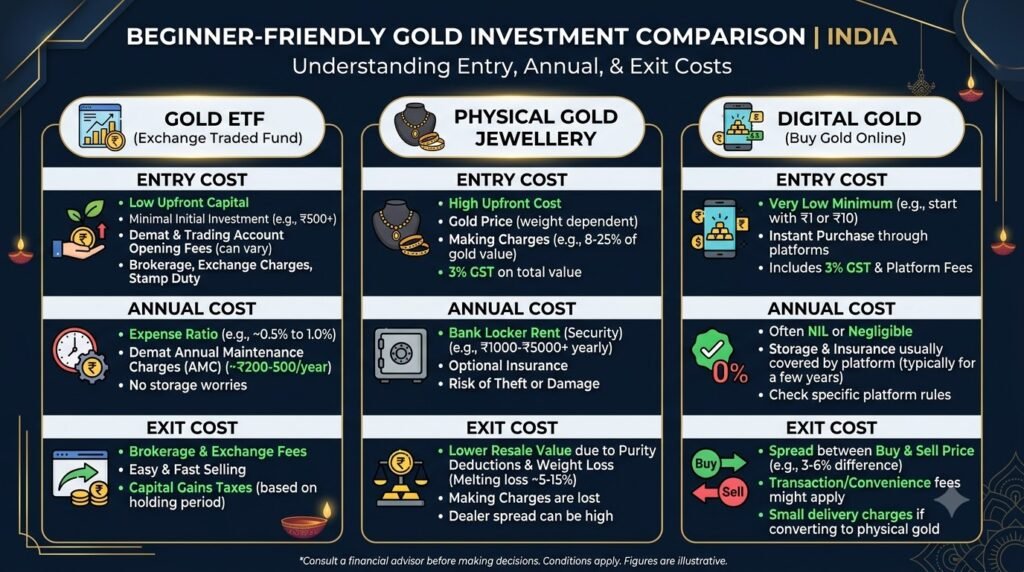
Real Cost Example: Investing ₹1 Lakh
Assume three investors each spend ₹1 lakh.
These numbers are illustrative. Actual charges vary by jeweller, ETF, broker and digital-gold provider.
Investor A: Physical Jewellery
Suppose the total price includes:
- Gold value
- GST
- 12% making charges
A meaningful part of the ₹1 lakh does not represent recoverable gold value.
If the investor sells the jewellery soon, the making charges may not be recovered.
Investor B: Gold ETF
The investor pays:
- Market price of ETF units
- Brokerage, if applicable
- Statutory transaction charges
- Bid-ask spread
- Annual expense ratio
Most of the invested amount obtains financial exposure to gold, although ongoing expenses create tracking difference.
Investor C: Digital Gold
The investor bears:
- GST
- Provider’s buy-sell spread
- Possible delivery or minting charges
- Possible storage-related conditions
The convenience is high, but the immediate resale value may be lower than the purchase amount.
Key Lesson
A gold product should not be judged only by the displayed gold price.
You must compare:
Entry cost + annual cost + exit cost + tax + risk
Which Option Gives the Best Returns?
Before costs, all three options are influenced primarily by the price of gold.
After costs, returns can differ.
Gold ETF Returns May Be Reduced By
- Expense ratio
- Tracking difference
- Brokerage
- Bid-ask spread
Physical Gold Returns May Be Reduced By
- GST
- Making charges
- Dealer premium
- Storage cost
- Insurance
- Resale deductions
Digital Gold Returns May Be Reduced By
- GST
- Buy-sell spread
- Delivery charges
- Storage charges
- Platform-specific fees
For pure investment purposes, Gold ETFs are usually more cost-efficient than jewellery.
However, the cheapest ETF is not automatically the best ETF. Liquidity, tracking difference, fund size, expense ratio and bid-ask spread should be considered together.
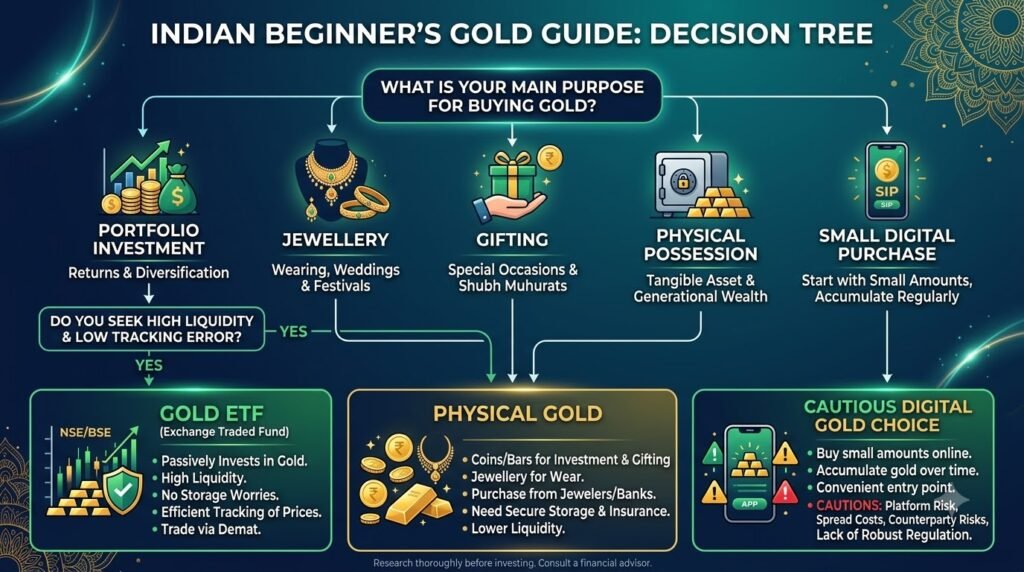
Which Option Is Best for Beginners?
Choose a Gold ETF When:
- You want gold for portfolio diversification
- You already have a demat account
- You want a regulated investment product
- You want relatively easy buying and selling
- You do not need physical delivery
- You understand market orders and limit orders
Choose Physical Gold When:
- You want jewellery for personal use
- You want to gift gold
- You value direct possession
- You are comfortable with storage responsibility
- You understand making charges and resale deductions
For investment, coins or bars are generally more efficient than jewellery—but they still involve GST, spreads, purity verification and storage.
Consider Digital Gold Only When:
- The purchase amount is very small
- Convenience matters more than investment efficiency
- You understand that it is not a SEBI-regulated security
- You have read the platform’s storage, redemption and delivery terms
- You accept counterparty and operational risk
Digital gold should not automatically become the place where you accumulate a major long-term gold portfolio simply because the payment app makes buying easy.
What Percentage of a Portfolio Should Be in Gold?
There is no universal allocation suitable for everyone.
A common educational range is approximately 5% to 15% of the investment portfolio, depending on:
- Age
- Risk tolerance
- Equity exposure
- Financial goals
- Existing jewellery holdings
- Income stability
- Investment horizon
This is not a recommendation.
Example
Suppose Rohan has:
- ₹6 lakh in equity funds
- ₹3 lakh in debt investments
- ₹1 lakh in a Gold ETF
His asset allocation is:
- Equity: 60%
- Debt: 30%
- Gold: 10%
Gold’s role here is diversification.
It is not expected to replace equity for long-term growth or debt for short-term capital stability.
Common Beginner Mistakes
1. Buying gold after a sharp rally because of FOMO
A rising price does not guarantee further returns.
Avoid investing a large lump sum merely because gold is making headlines.
2. Treating jewellery as a high-return investment
Making charges and resale deductions can materially reduce returns.
3. Assuming digital gold is regulated like a mutual fund
It is not.
SEBI has specifically cautioned investors about the absence of securities-market protection for ordinary digital-gold products.
4. Selecting a Gold ETF only by expense ratio
Also check:
- Tracking difference
- Trading volume
- Bid-ask spread
- Fund size
- AMC disclosures
5. Ignoring existing family gold
An investor who already has substantial exposure through coins, bars or saleable jewellery may not need a large additional gold allocation.
6. Buying jewellery with borrowed money
Gold jewellery is a discretionary purchase.
Taking expensive debt to purchase it can damage your finances.
7. Expecting gold to generate income
Gold does not normally produce:
- Dividends
- Rent
- Business earnings
- Interest
Your return primarily depends on price appreciation after costs.
Frequently Asked Questions
1. Is a Gold ETF better than physical gold?
For portfolio investment, a Gold ETF is generally more efficient because it avoids personal storage, purity concerns and jewellery making charges. Physical gold is more suitable for jewellery, gifting and direct possession.
2. Is digital gold safe in India?
Digital gold may involve insured vaulting and private contractual safeguards, but it is not regulated by SEBI as a security. SEBI has warned that investors may face counterparty and operational risks without securities-market investor-protection mechanisms.
3. Can I lose money in a Gold ETF?
Yes. A Gold ETF’s value can fall when gold prices decline. Returns can also lag the underlying price because of expenses and tracking difference.
4. Does a Gold ETF contain real gold?
Gold ETF schemes generally invest primarily in physical gold or permitted gold-related instruments according to their scheme documents and regulatory requirements.
5. Is GST charged on Gold ETFs?
Buying ETF units is not the same as directly purchasing physical gold. Investors instead bear securities-transaction charges, brokerage where applicable, stamp duty, bid-ask spread and the scheme’s expense ratio.
6. Is GST charged on digital gold?
Digital-gold purchases generally attract GST because the transaction represents a purchase of gold through the provider.
7. Is jewellery a good investment?
Jewellery is generally inefficient as a pure investment because making charges, design costs, GST and resale deductions can reduce returns.
8. Do I need a demat account for a Gold ETF?
Yes. Gold ETFs are bought and sold on stock exchanges through a trading and demat account.
9. Can I invest monthly in a Gold ETF?
Yes. You can purchase units periodically through your broker. However, the execution process may differ from an automatic mutual-fund SIP.
10. Can I take physical delivery from a Gold ETF?
Retail investors ordinarily buy and sell ETF units on the exchange. Physical creation or redemption may involve large creation-unit requirements and scheme-specific conditions.
11. Which is more liquid: Gold ETF or physical gold?
A liquid Gold ETF can usually be sold during exchange hours. Physical gold liquidity depends on the buyer, purity testing and dealer’s buyback terms.
12. Which has the lowest cost?
For portfolio exposure, a liquid, low-cost Gold ETF is often more efficient than jewellery or digital gold. Actual cost depends on the ETF’s expense ratio, spread and brokerage.
13. Is digital gold better for a ₹100 investment?
Digital gold is convenient for very small purchases, but investors must still consider GST, spreads and lack of SEBI regulation. Saving ₹100 in a diversified mutual fund or recurring investment may be more suitable depending on the goal.
14. How much gold should a beginner hold?
There is no universal rule. A limited allocation within a diversified portfolio may be considered based on the investor’s objectives and existing gold exposure.
15. Is gold a safe investment?
Gold does not carry the same business risk as an individual company, but its market price can still fall. “Safe” does not mean guaranteed returns.
16. Does gold beat inflation?
Gold has sometimes protected purchasing power over long periods, but it may underperform inflation during particular periods. It is not a guaranteed inflation hedge every year.
17. Can I replace debt investments with gold?
Usually not. Debt and gold perform different portfolio functions. Gold can be volatile and may not be suitable for money required on a fixed short-term date.
18. Should I buy gold when prices are at record highs?
Do not make the decision solely on a record-high headline. Consider your asset allocation, horizon and whether you are investing due to FOMO.
19. Is a gold mutual fund the same as a Gold ETF?
No. A gold mutual fund usually invests in a Gold ETF and can be purchased without a demat account. It may involve an additional expense layer.
20. What is the best gold option in 2026?
For portfolio investment, Gold ETFs are generally the most balanced choice among Gold ETFs, physical gold and ordinary digital gold. Personal requirements may justify physical gold, while digital gold should be approached with greater caution.
Conclusion
Gold can improve portfolio diversification, but only when used with discipline.
Do not purchase gold merely because relatives, influencers or headlines say prices will rise.
First decide why you need it.
For jewellery and gifting, physical gold serves a real purpose.
For investment and rebalancing, Gold ETFs provide a more regulated and efficient structure.
For small digital purchases, carefully evaluate whether convenience justifies the additional regulatory and counterparty risks.
Gold should support your financial plan—not replace it.
Disclaimer
This article is published for educational and informational purposes only. It does not constitute investment advice, tax advice, legal advice, financial planning advice, or a recommendation to buy, sell, or hold any financial product.
Also read:–> Should You Stop SIP During Market Correction?