
Introduction
The Reserve Bank of India has kept the repo rate unchanged at 5.25% in its August 2026 Monetary Policy Committee meeting.
For an ordinary person, this announcement creates several questions:
- Kya home loan EMI kam hogi?
- Kya FD interest rates badhenge?
- Kya ab fixed-rate loan lena better hai?
- Existing borrowers ko kya karna chahiye?
- Kya repo rate unchanged hone ka matlab sab interest rates unchanged rahenge?
The simple answer is: not necessarily.
Repo rate banking system ka ek important signal hai, but your final home loan rate, FD return or personal loan rate depends on several other factors too.
In this guide, we will understand the RBI repo rate in simple language and see how the August 2026 decision can affect your money.
Table of Contents
- Latest RBI Repo Rate Decision
- Repo Rate Kya Hota Hai?
- Repo Rate Unchanged Ka Meaning
- Home Loan EMI par Impact
- EMI Calculation Example
- Fixed Deposit par Impact
- Personal and Car Loan Impact
- Savers and Borrowers Ko Kya Karna Chahiye?
- Common Mistakes
- FAQs
- Final Conclusion
RBI Repo Rate Decision: August 2026
The RBI Monetary Policy Committee met from 3 August to 5 August 2026.
The committee unanimously decided to:
| Policy Measure | August 2026 Decision |
|---|---|
| Repo rate | 5.25% |
| Standing Deposit Facility rate | 5.00% |
| Marginal Standing Facility rate | 5.50% |
| Bank Rate | 5.50% |
| Monetary-policy stance | Neutral |
The repo rate was kept unchanged, which means the RBI neither increased nor reduced its main policy lending rate in this meeting.
The RBI also projected real GDP growth of 6.7% for 2026–27, while highlighting global uncertainty, energy-price risks and uneven monsoon conditions.
What does a neutral stance mean?
A neutral stance means the RBI has not committed itself to either cutting or increasing rates in the next meeting.
It will study inflation, economic growth, global conditions, crude-oil prices and financial-market developments before taking the next decision.
Simple words mein:
RBI फिलहाल “wait and watch” mode mein hai.
Repo Rate Kya Hota Hai?
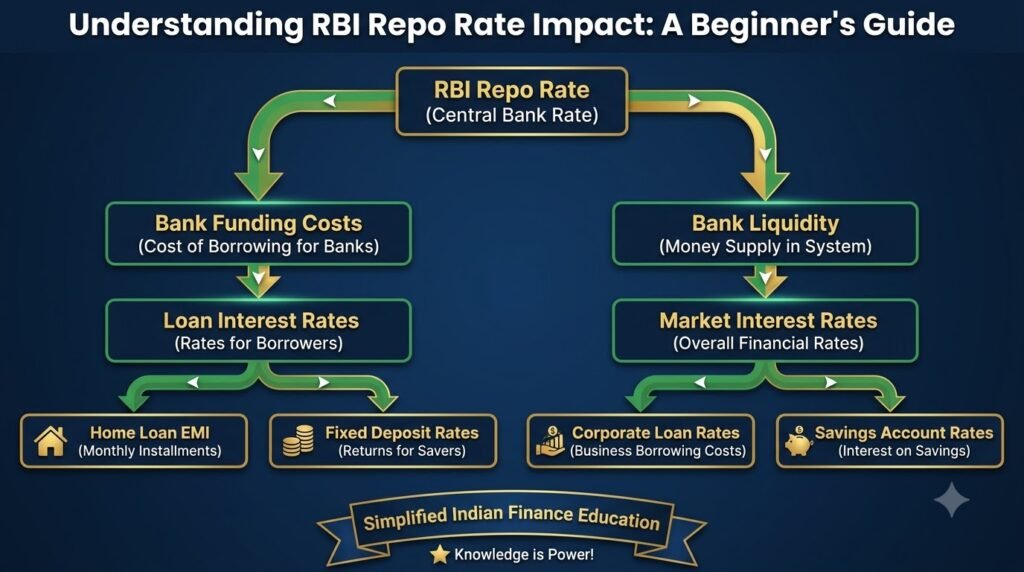
Repo rate is the interest rate at which the Reserve Bank of India lends short-term money to eligible banks against approved securities.
Suppose a bank needs short-term funds.
It may borrow money from the RBI and pay interest according to the prevailing repo rate.
When the repo rate changes, the cost of money in the banking system can also change.
Simple example
Imagine that a shopkeeper purchases goods from a wholesaler.
Agar wholesaler price badha deta hai, shopkeeper bhi gradually customer price badha sakta hai.
Similarly, when the RBI increases the repo rate, banks’ cost of borrowing may rise. Banks may then increase lending rates.
When the RBI cuts the repo rate, loans may gradually become cheaper—provided banks pass the benefit to borrowers.
Repo Rate Unchanged Hone Ka Kya Meaning Hai?
A repo rate of 5.25% remaining unchanged does not mean that every loan and FD rate will remain frozen.
It simply means that there is no fresh policy-rate increase or reduction from the RBI.
Banks can still change their interest rates because of:
- Deposit mobilisation requirements
- Credit demand
- Liquidity conditions
- Cost of funds
- Borrower risk profile
- Competition between banks
- Changes in a loan’s internal spread
- MCLR reset dates
- Bank-specific business strategy
RBI research shows that lending and deposit rates generally move with the repo rate, but the speed and extent of transmission can differ across banks and monetary-policy cycles.
Home Loan EMI par Kya Asar Hoga?
The impact depends mainly on the type of home loan you have.
1. Repo-Linked Floating-Rate Home Loan
Many newer floating-rate retail loans are linked to an external benchmark such as the RBI repo rate.
The final loan rate may look like this:
Home loan interest rate = Repo rate + Bank spread
For example:
- RBI repo rate: 5.25%
- Bank spread: 2.75%
- Final home loan rate: 8.00%
Because the repo rate has not changed, there may be no immediate benchmark-driven change in your loan rate.
However, the bank’s spread, reset schedule and loan terms must also be checked.
The RBI’s external-benchmark framework was introduced to improve transparency and speed up the transmission of policy-rate changes to eligible floating-rate loans.
2. MCLR-Linked Home Loan
Older loans may be linked to the Marginal Cost of Funds-Based Lending Rate or MCLR.
MCLR does not move exactly with the repo rate.
It depends on the bank’s deposit cost, borrowing cost, operating cost and other factors.
Therefore, even when the repo rate is unchanged, a bank may revise its MCLR.
Your rate will generally change only on the loan’s scheduled reset date.
3. Fixed-Rate Home Loan
A genuine fixed-rate home loan normally does not change because of a repo-rate decision during the agreed fixed-rate period.
But borrowers should carefully read the loan agreement.
Some loans are fixed only for an initial period and later convert into floating-rate loans.
Will Your EMI Remain the Same?
Possibly—but check your loan statement.
When interest rates change on a floating-rate EMI loan, the lender may:
- Increase or decrease the EMI
- Extend or reduce the loan tenure
- Adjust both EMI and tenure
RBI instructions require regulated lenders to communicate the effect of benchmark-rate changes. Borrowers must also be given choices relating to EMI enhancement, tenure extension, a combination of both, and partial or complete prepayment, subject to applicable rules.
The lender must also make a quarterly statement available showing important details such as:
- Principal repaid
- Interest recovered
- Current EMI
- Remaining EMIs
- Annualised interest rate or APR
Important point
Repo rate unchanged hone ke baad bhi apni EMI statement check karna useful hai.
Your bank may be applying an earlier rate change on the current reset date.
Home Loan EMI Calculation Example
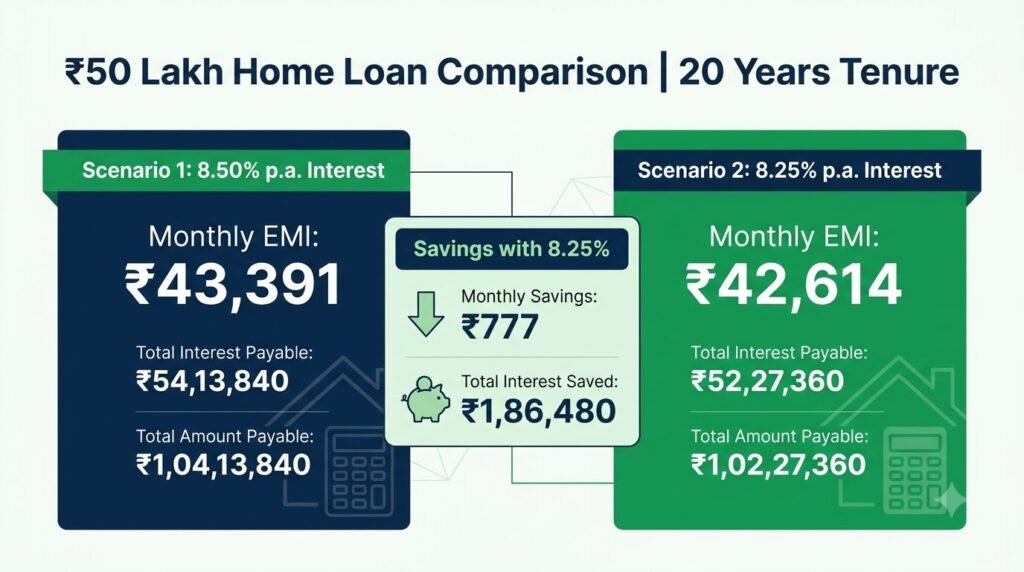
Man lijiye aapka outstanding home loan is:
| Loan Detail | Value |
| Outstanding principal | ₹50,00,000 |
| Remaining tenure | 20 years |
| Current interest rate | 8.50% |
| Approximate EMI | ₹43,391 |
Now suppose the interest rate were 8.25% instead of 8.50%.
The approximate EMI would be:
₹42,603 per month
That is a difference of approximately:
₹788 per month
Over one year, the cash-flow difference would be around:
₹9,456
This example shows why even a 0.25% change can matter on a large and long-term loan.
However, because the RBI kept the repo rate unchanged in August 2026, this example is only to explain rate sensitivity. It does not mean that every borrower will receive a 0.25% reduction.
Should You Prepay Your Home Loan?
Repo rate unchanged hone ke baad panic mein prepayment karna necessary nahi hai.
Consider these factors first:
Prepayment may make sense when:
- You already have an emergency fund
- You have no high-interest credit-card debt
- Your loan rate is relatively high
- You want to become debt-free earlier
- Prepayment does not disturb long-term investments
- You are comfortable with lower liquidity
Prepayment may not be the first priority when:
- You do not have an emergency fund
- Your job income is uncertain
- You have costly personal-loan or credit-card debt
- You need money for a near-term goal
- Prepayment would force you to stop essential insurance or retirement investing
A home loan is a long-term commitment. The correct decision depends on your complete financial situation, not only the latest repo-rate announcement.
Fixed Deposit Interest Rates par Kya Asar Hoga?
For FD investors, an unchanged repo rate means there is no immediate new policy-rate signal forcing banks to raise or cut deposit rates.
However, FD rates can still change.
Banks may revise FD rates based on:
- Their need for fresh deposits
- Loan demand
- Existing liquidity
- Maturity-wise funding requirements
- Competition from other banks
- Small savings and bond yields
- Expected future policy direction
RBI research has found that bank term-deposit rates broadly respond to repo-rate changes, but deposit-rate transmission may differ from lending-rate transmission. Savings-account rates can also remain relatively rigid.
Existing FD Investors
A traditional fixed-rate FD usually continues at the contracted rate until maturity.
Suppose you booked a three-year FD at 7%.
Even if the bank later reduces its new FD rate to 6.5%, your existing FD will generally continue earning 7% until maturity, subject to its terms.
New FD Investors
New investors should not lock all their money into one long-duration FD only because the current rate looks attractive.
A better approach can be an FD ladder.
What Is an FD Ladder?

An FD ladder means dividing your money across different maturity periods.
For example, suppose you want to invest ₹6 lakh.
Instead of creating one five-year FD, you can divide it like this:
| FD Amount | Tenure |
| ₹1,50,000 | 1 year |
| ₹1,50,000 | 2 years |
| ₹1,50,000 | 3 years |
| ₹1,50,000 | 4 years |
As each FD matures, you can reinvest it according to the interest rates and your financial needs at that time.
Benefits of an FD ladder
- Better liquidity
- Lower reinvestment risk
- Regular maturity opportunities
- Less dependence on one interest-rate level
- Easier goal planning
Limitation
An FD ladder does not guarantee higher returns.
It simply reduces the risk of locking your entire amount at an unfavourable rate
FD Return Example
Suppose you invest ₹5 lakh for three years.
At 7% annual compounding, the maturity amount will be approximately:
₹6,12,522
At 6.5%, the maturity amount will be approximately:
₹6,03,975
Difference:
₹8,547
This shows that even a 0.5% rate difference matters, especially on larger deposits.
But do not choose an FD only on the basis of the highest advertised rate.
Also check:
- Bank safety and credibility
- Premature withdrawal penalty
- Senior-citizen rate
- Interest payment frequency
- Auto-renewal instructions
- Tax impact
- Deposit-insurance limits
- Your liquidity requirement
Personal Loan aur Car Loan par Impact
Personal loans and car loans may be fixed-rate or floating-rate depending on the lender and product.
Personal Loan
Most personal loans carry higher interest rates than secured loans because they are unsecured.
An unchanged repo rate does not guarantee that personal-loan rates will remain unchanged.
Your rate depends heavily on:
- Credit score
- Income stability
- Employer profile
- Existing debt
- Loan amount
- Repayment period
- Lender’s internal pricing
Car Loan
Car-loan rates may also differ by:
- Vehicle type
- New or used car
- Credit score
- Down payment
- Loan tenure
- Relationship with the bank
Always compare the annual percentage rate and total repayment, not only the advertised starting rate.
What Should Borrowers Do Now?
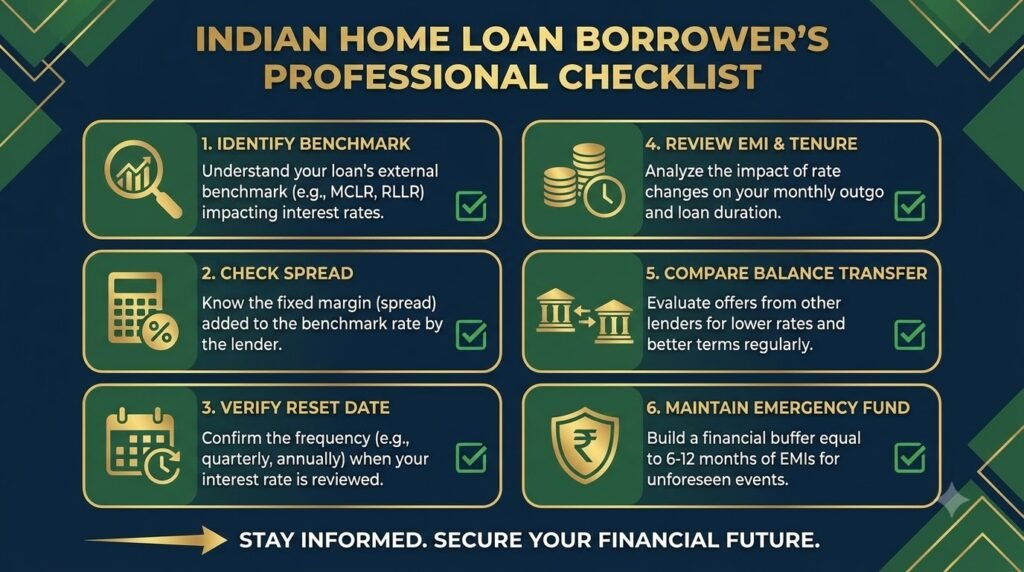
Action Step 1: Identify Your Loan Benchmark
Check whether your loan is linked to:
- Repo rate
- Another external benchmark
- MCLR
- Base rate
- A fixed rate
This information should be available in your sanction letter, loan agreement or account statement.
Action Step 2: Check the Spread
Two borrowers can have different final interest rates even when their loans use the same benchmark.
This happens because the lender may charge different spreads based on risk, loan size and product terms.
Ask the bank:
“What is my current benchmark, spread and effective annual interest rate?”
Action Step 3: Check the Reset Date
A benchmark change may not appear immediately.
Your loan agreement will mention the reset frequency.
Action Step 4: Compare Balance Transfer Carefully
A lower advertised rate does not automatically make a balance transfer profitable.
Calculate:
- Processing fee
- Legal charges
- Valuation fee
- Documentation costs
- Remaining tenure
- Interest saving
- Time and administrative effort
A balance transfer is generally more useful when the outstanding principal and remaining tenure are still meaningful.
Action Step 5: Improve Your Credit Profile
A good repayment history and lower debt burden may improve your bargaining position.
You can request your existing lender to review the spread, though approval is not guaranteed.
What Should FD Investors Do Now?
For Short-Term Goals
If money is needed within one to three years, prioritise safety and liquidity.
Do not move essential short-term money into equities merely because you are worried that FD rates may fall.
For Emergency Funds
Keep emergency money in accessible instruments.
A combination of savings account, sweep FD and short-duration deposits may be more practical than locking everything for several years.
For Retirees
Retirees should focus on:
- Predictable cash flow
- Credit quality
- Liquidity
- Taxation
- Diversification across maturities
- Avoiding concentration in one institution
The highest rate is not always the safest option.
Advantages and Disadvantages of an Unchanged Repo Rate
Possible Advantages
- Borrowers do not face a fresh RBI-driven rate increase
- Existing repo-linked EMI pressure may remain stable
- Savers may continue to find reasonable FD opportunities
- Households receive more policy stability
- Financial planning becomes slightly more predictable
Possible Disadvantages
- Borrowers waiting for an immediate EMI reduction may be disappointed
- Banks may still revise rates independently
- FD investors cannot assume current rates will remain available
- Future rate direction remains uncertain
- High-interest borrowers may continue paying expensive EMIs
Summary Box
RBI decision: Repo rate unchanged at 5.25% on 5 August 2026.
For home loan borrowers: No fresh repo-driven increase or decrease, but check your benchmark, spread and reset date.
For FD investors: Rates may remain competitive, but banks can revise them independently.
For new borrowers: Compare the effective interest rate, total fees and loan conditions.
For existing borrowers: Review EMI, tenure, spread and balance-transfer economics.
Best approach: Do not make a financial decision based only on one RBI announcement.
Frequently Asked Questions
1. What is the RBI repo rate in August 2026?
The RBI repo rate is 5.25% after the Monetary Policy Committee kept it unchanged on 5 August 2026.
2. Will home loan EMI decrease after the August 2026 policy?
There is no fresh repo-rate cut, so repo-linked borrowers should not expect an automatic reduction solely because of this policy. Bank-specific changes and earlier reset adjustments may still affect the loan.
3. Can banks change home loan rates when the repo rate is unchanged?
Yes. MCLR, funding costs, spreads and internal pricing may change independently, depending on the loan agreement.
4. Will FD rates increase now?
An unchanged repo rate does not automatically increase FD rates. Banks can raise or reduce deposit rates depending on their funding needs and liquidity.
5. Is this a good time to book a long-term FD?
It depends on your goal, liquidity needs and expectations. An FD ladder may be better than investing the entire amount at one maturity.
6. What is the difference between repo-linked and MCLR-linked loans?
Repo-linked loans use an external benchmark and can transmit policy changes relatively quickly. MCLR is based largely on the bank’s internal cost of funds and resets according to the loan terms.
7. Should I transfer my home loan to another bank?
Consider a transfer only after calculating interest savings, fees, remaining tenure and administrative costs.
8. Should I increase my EMI?
Increasing EMI can reduce loan tenure and total interest, but it should not weaken your emergency fund or other important goals.
9. Can I switch from a floating rate to a fixed rate?
A lender may provide this option according to its policy, with applicable charges and conditions. RBI instructions require transparent disclosure of relevant costs.
10. What is the next RBI repo-rate decision?
The policy schedule can change, so readers should check the RBI’s official monetary-policy page for the latest meeting date.
Conclusion
The RBI’s decision to keep the repo rate unchanged at 5.25% provides some stability, but it does not freeze every home loan, FD or personal-loan rate.
For borrowers, the most important things are the loan benchmark, spread, reset date, remaining tenure and prepayment options.
For FD investors, the focus should be safety, liquidity, taxation and maturity planning—not only the highest available rate.
Repo rate headlines are important, but good financial decisions are based on your complete financial plan.
Aapka goal rate predict karna nahi hona chahiye. Aapka goal aisa financial plan banana hona chahiye jo changing rates ke bawajood kaam kare.
Call to Action
Is article ko bookmark karein and every RBI policy meeting ke baad apne home loan rate, EMI, remaining tenure and FD maturity plan ko review karein.
For more beginner-friendly finance guides, visit CompoundingLab.in.
Disclaimer
This article is published for educational and informational purposes only. It should not be considered financial, investment, tax, legal or loan advice.
Interest rates, RBI policies, bank lending rates, fixed deposit rates, fees and loan terms may change over time. The actual impact on your EMI, loan tenure or FD return will depend on your lender, loan agreement, benchmark, spread, reset date, credit profile and applicable terms.
The calculations and examples used in this article are illustrative and may not reflect your actual repayment amount or investment return. Readers should verify the latest information from the Reserve Bank of India, their bank or another relevant official institution before making a financial decision.
CompoundingLab.in does not guarantee the accuracy, completeness or continued validity of third-party information and is not responsible for any financial loss arising from decisions made solely on the basis of this article.
Please consult a qualified financial adviser, tax professional or lending specialist where personalised advice is required.
Also, Read:—> Is ₹5,000 Monthly SIP Enough to Build ₹1 Crore?
Gold ETF vs Physical Gold vs Digital Gold in 2026: Which Is Best for Indian Investors?